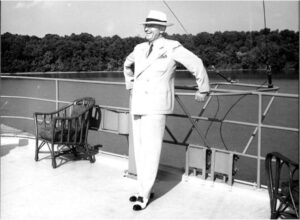
Short Term Skipper  President Harry S. Truman

Short Term Skipper President Harry S. Truman

Vice President Harry Truman liked to spend afternoons with a bourbon and branch at House Speaker Sam Rayburn’s “Board of Education” hideaway.   When he arrived on April 12, 1945, Rayburn told Truman to call Steve Early in the White House right away.  Truman dialed National 1414 and was told to come to the White House as “quickly and quietly” as he could.  It sounded ominous.  Truman lost his color muttering, “Jesus Christ and General Jackson.”  

When he arrived, Mrs. Roosevelt put her arm on Truman’s shoulder.  “Harry, the President is dead.”   Unable to speak at first, he finally managed, “Is there anything I can do for you.”  She replied, “Is there anything we can do for you …. You are the one in trouble now.”

He took the oath of office at 7:09 p.m., two hours and 24 minutes after FDR’s death at Warm Springs, Georgia.  Truman had been Vice President for 82-days.  He had met with President Roosvelt only twice, except for cabinet meetings.  He was not aware of the Manhattan project to develop the atomic bomb or the results of FDR’s just completed Yalta conference with Churchill and Stalin.  He had not met the new Secretary of State, Edward Stettinius.

So ended an era and so began another.[1]  The Presidential Yacht Potomac had a new skipper.   

The new President had a lot going on.  He moved from his $120 monthly rental apartment to Blair House across from the White House while Mrs. Roosevelt packed and then another move to the White House.  He had met with Vyacheslav Molotov, the Russian prime minister.  On April 24, he received a note from Secretary of War Stimson saying, “I think it is very important that I should have a talk with you as soon as possible on a highly secret matter.”[2]   On April 25 he opened the San Francisco UN conference by radio from the White House.  He celebrated his 61st birthday on May 8.  On that same day Alfred Jodl, the chief of staff of the German High Command signed Germany’s unconditional surrender, at General Eisenhower’s headquarters in Reims, France.  Truman announced Germany’s surrender in a radio address from the White House. On June 26, he delivered an address in San Francisco at the closing of the U.N Charter Conference.

Amidst this activity, he scheduled his first cruise as President on the Potomac on a sunny May 6 Sunday.  It was strictly a family affair, the President, his wife Bess and daughter Margaret.   Together with five secret service men, they boarded the yacht and cruised down the Potomac River for about three hours before returning to the Navy Yard berth at about 5:30 p.m.

On May 11, Truman sent his four-engine plane the Sacred Cow[3] to pick-up his 92-year-old mother Martha Ellen Young Truman and his 56-year-old sister Mary Jane for their first visit with the new president in the White House. When offered bedding in the Lincoln Room, the President’s mother, a true confederate, said she instead preferred the floor.  Alternative sleeping was arranged.   They had arrived in time for a Mother’s Day cruise on the Potomac.

The Potomac was not just for the family.  There was also time for the boys.  On May 29-30, the President hosted a poker party on the ship overnighting at anchor offshore of Quantico, VA, marine base with Harry Vaughan, Captain James Vardaman, Jr., George Allen, Steve Early and George Allen.   The President wrote in his diary “his sides were sore from laughing.”

The new President’s greatest early challenge was the forthcoming Potsdam World War II conference in Germany. He was scheduled to meet with Stalin and British leadership to plan for a post war world with an increasingly hostile Russian ally.  Without the benefit of any direct input from President Roosevelt, Truman had a major research project to prepare for meeting and negotiating with his more seasoned counterparts.  A quick study, he took to the files and records plus getting input from participants in the earlier war conferences.

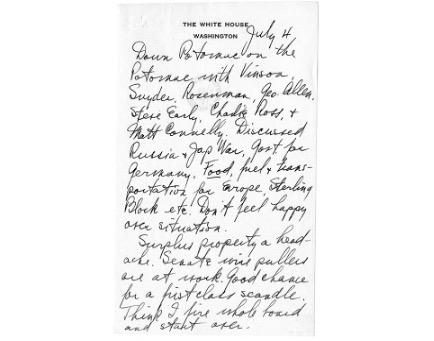
Before leaving for Potsdam on the USS Augusta[4], he boarded the USS Potomac on July 4, 1945, for a working cruise to prepare for the war conference and discuss other strategic issues including the war with Japan.  Joining him aboard were Fred M. Vinson, John W. Snyder, Samuel I. Rosenman, George Allen, Steve Early, Charlie Ross, Capt Vardaman, and Matt Connelly for a 9:24 a.m. departure returning at 4: 49 p.m.  Truman made a handwritten note to himself from the Potomac:

 “Down Potomac … Discussed Russian & Jap War, Govt for Germany, Food, fuel & transportation for Europe, Sterling Block, etc.  Don’t feel happy over situation.”

He also noted: “I have to decide Japanese strategy—shall we invade Japan proper, or shall we bomb[5] and blockade?  That is my greatest decision to date.  But I’ll make it when I have all the facts. So you see, we talk more than ‘Cabbages & Kings and Sealing wax and things.’”


Snyder, Rosenman and Allen later wrote a memorandum summarizing the issues discussed with the President on the July 4 Potomac cruise including strategies for the Potsdam conference that concluded after a long list of priorities:

“In other words, we think that as a well known Missouri horse trader, the American people expect you to bring something home to them.”

Just what he didn’t need …. more pressure!

After the July 4 Potomac discussions, he continued preparing for Potsdam with long hours at the White House before departing for the conference on board the USS Augusta on July 7 from Newport News, VA.  Like the support for FDR’s war councils, Truman was accompanied by 11 members of the Filipino mess crew from the Presidential Yacht USS Potomac.  Included was Chief Steward Irineo Esperancilla, a favorite of President Roosevelt.  Another Filipino on this trip from the Potomac was Benjamin Licodo.  He had been on the PT Boat that took General MacArthur and his family off Corregidor but stayed behind for two years fighting the Japanese in guerrilla warfare.[6]

The Potomac mess crew provided culinary support throughout the July 17 to August 2 Potsdam Conference.   After the conference returning to Washington D.C. on the USS Augusta, President Truman authorized the dropping of the first atomic bomb on Hiroshima, Japan, by a B-29 bomber on August 6.  A second bomb was dropped on Nagasaki on August 9.

September 3, 1945, is the last entry on the USS Potomac logs showing President Truman onboard.  He was joined by his wife Bess for a day cruise passing Mount Vernon on the voyage up and down the river rendering “passing honors” on each occasion.

Victimized by its conversion from a “rum chaser” coast guard cutter, the Potomac was “top heavy” with new upper decks outfitted for a presidential yacht. Consequently, she was restricted  to inland waters.  The new President selected the larger and more seaworthy USS Williamsburg as his new replacement presidential yacht.

The USS Potomac was decommissioned as a Navy vessel on Nov. 18, 1945.

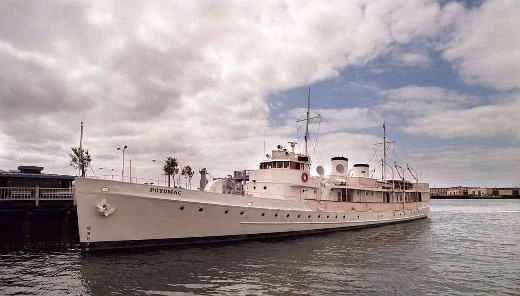
See USS Potomac mini-history “From a ‘Rum Chaser’ to a ‘Drug Runner’” for the saga of the ship now fully restored as Franklin Roosevelt’s Presidential Yacht at Jack London Square in Oakland, California, by the Association for the Preservation of the Presidential Yacht Potomac.  The Potomac is the oldest Navy ship (decommissioned) still in daily operation.


[1] Source: “Truman” by David McCullough

[2] The “matter” was the atom bomb dropped first on Hiroshima on Aug 6, 1945, as authorized by President Truman

[3] AKA “The Flying White House”

[4] The USS Augusta (Georgia not Maine) was a heavy cruiser used by President Roosevelt for his 1941 secret meeting with Prime Minister Winston Churchill when he was supposed to be fishing on the USS Potomac.

[5] The Trinity test of the first atomic weapon in the desert of New Mexico remined 12 days away.

[6] Source: “White House Sailor” by William M. Rigdon with James Derieux

From a “Rum Chaser” to a “Drug Runner”

From a “Rum Chaser” to a “Drug Runner”

For fourteen years between1920 and late 1933, the United States was “dry.”   The 18th Amendment to the U.S. Constitution, “Volstead Act,” prohibited alcoholic sales, manufacture, and consumption throughout the United States.

Still despite the “cure,” the public generally wanted its liquor. A widely held public attitude to ignore the law followed.  In the 1920’s, New York City’s Mayor Fiorello LaGuardia said it would take “250,000 policemen to enforce the law and an equal number to watch them.”  Gangsters grew rich.   It was estimated Al Capone earned $60 million a year (he should have paid his taxes). Sacramental wine was still permitted for religious purposes.  The number of questionable rabbis and priests skyrocketed. New York City boasted more than 30,000 speakeasies, and Detroit’s alcohol trade was second only to the automobile industry in its contribution to the economy.

Prohibition created a whole new industry … rum running.   A fleet of ships hovered outside the 12-mile sea limit out of reach to the U.S, Coast Guard seizing opportunities to bring their contraband off-shore alcoholic cargo to the eager American market.  At the start of Prohibition, no one predicted the level of smuggling from sea to follow.  By 1924, it was estimated that the Coast Guard was apprehending about 5% of the “rum runners” with its fleet of about “…200 vessels at sea attending to the rummies at any given time.”[1]

In the Napa Valley “creative” wineries managed to survive usually by making wine for permitted religious purposes, one of the loopholes in the 18th Amendment.  Other wineries made wine for home use, turned their grapes into raisins or simply sold their grapes directly to customers.  Could it have been possible that, maybe, some bottles even  found their way to the  speakeasies?  Surviving Napa Valley wineries included Beringer, Beaulieu, Charles Krug, Louis M. Martini, Freemark Abbey and Larkmead.

In October 2029, the stock market crashed.  The 1920’s “roar” was now silent.  For nearly three years stock prices declined irregularly, losing almost 90 per cent of their 1929 value.  A nationwide change in public sentiment about Prohibition was underway.   More and more were agreeing that the “cure” had been worse than the “disease.”    Also, the “sick” Great Depression economy needed taxes from alcohol sales and lessened law enforcement expenditures. 

When Franklin Roosevelt made his 1932 nomination acceptance, he announced that Prohibition was doomed. Congress started the process before his inauguration.   On his eighth day in office, he told his advisors, “It’s time the county did something about beer.”  Less than 30-hours later the “beer bill” passed among the FDR’s New Deal legislation.  On April 6, 1933, a police detail escorted a beer truck to the White House under a sign reading, “President Roosevelt, the first real beer is yours.”

[2]Ratification of the appeal was needed by 36 States which Utah provided and on Dec. 5, 1933, the 21st constitutional amendment repealed the Volstead Act and Prohibition came to an end.   A failed move to remake private behavior was over after 14 years.

Perhaps, our country has always been divided.  During Prohibition it was “wet” versus “dry.”   FDR was “wet.”   Eleanor was “dry.”   FDR’s mother, Sarah, was “dry” and even post repeal continued to enforce her local prohibition in the family home at Hyde Park.

The USS Potomac was first born as the Coast Guard Cutter Electra in the design style developed in World War I for submarine chasers with sharp lines…  a racked bow and cruiser stern … for speed to combat smuggling.  The first of these new sleek “Rum Chasers” was launched in 1931.   The Electra was the seventeenth of the series and delivered in 1934 after Prohibition had been reappealed two years earlier.   Construction had continued.  Coastal patrol was still a priority including a new threat from offshore “tax free” liquor.   The Electra spent her first eleven months patrolling the coast.   

Meanwhile, President Roosevelt was using the wooden-hulled Sequoia from 1933 to 1936 as his presidential yacht.  Uncomfortable with her from the outset, FDR began looking for a replacement almost immediately.  He was taken by the clean lines and functional appearance of the Electra class of Coast Guard cutters.  Also, he was comforted by the Electra’s steel hull for fire prevention and better design for deep-sea fishing. 

She was politically correct  … “devoid of the varnished hardwood, polished brass and interior finery found on the Sequoia, the Electra was firm, austere and businesslike …  altogether a thoroughly proper yacht for a president leading his country out of the worst economic depression in history.”[3] 

The press release announcing her selection as the new presidential yacht only mentioned that she was able to carry more passengers.  

The subchaser Electra was transferred from the Coast Guard to the U.S. Navy in 1935 and classified as AG25 (“Auxiliary Miscellaneous”).  Now a new name had to be chosen, not a simple process.  The President considered a wide choice including ship names from throughout American history.  While at Warm Springs, he selected “POTOMAC” from a wide list and issued a memo …  “The name has been changed from the Electra to the Potomac.”

The Norfolk Navy Yard was designated as the Potomac’s home yard and Washington, D.C. was assigned her home port where she was transformed into a presidential yacht including a hand operated elevator concealed in a new after stack that allowed the president to appear magically on one dock or the other.  The conversion cost was $60,000.

The Potomac was commissioned as a Navy vessel on March 2, 1936, at the Norfolk Navy Yard.  Her first voyage as the presidential yacht was an extended fishing trip off the coast of Florida that began on March 23, 1936.  It was the first of many similar trips off the Atlantic and Gulf coast and the southern waters[4].

FDR loved the time he relaxed and contemplated on the Potomac.  Additionally, she served strategically as secret transport for two of his World War II international conferences …. Atlantic Conference in 1941 with Churchill and the Teheran Conference with Churchill and Stalin in 1943 to finalize D-Day planning for the Normandy Invasion.

Cocktails were part of the daily routine on the USS Potomac post prohibition including FDR’s specially crafted martini (Stalin said it was cold on the stomach).  Still the “drys” including his mother exercised their authority.   After a luncheon cruise on the yacht for King George VI and Queen Mary in 1939, the royal couple visited his mother’s Big House at Hyde Park.  FDR told the king that his mother did not approve of cocktails and thought he should have a cup of tea.  The king reflected for a moment and observed, “Neither does my mother.”  They raised their glasses and proceeded to drink their martinis.[5]

When President Roosevelt died at Warm Springs on 1945, the Potomac’s  days as presidential yacht were numbered.  Later that year, she was returned to the Coast Guard and sold to the State of Maryland on July 16, 1946.   Purchase price $10 including provisions and supplies.  At some point during the Maryland era, the state removed the after stack with FDR’s hand-operated elevator which is currently a monument to the president at Cambridge, Maryland.  In 1958, there was a nautical accident with the dredge Arlington that damaged both propellers and a rudder post.  That was enough.   The state started looking for buyers.   She was sold to Warren G. Toone in 1960 for $65,000, later less $8,000 for repairs revealed by a survey.

This started a downhill path that would lead her literally underwater. She now pointed her bow toward the Caribbean for a proposed inter-island ferry service between the Virgin Islands and Puerto Rico which did not happen.  She languished in Barbados accumulating unpaid bills and lacking maintenance.  The yacht became unseaworthy. 

Hydro-Capital bought the ship planning a restoration and journey to appear at the Seattle’s World Fair (Century 21 Exposition).  In 1962 a crew of ten arrived from Los Angeles to make her seaworthy for the journey to Seattle.  Some progress was made, and she started her West Coast journey but with more hard luck on the horizon including the loss of her starboard engine.  After passing the Panama Canal, heading for California into swells so adverse she ran out of fuel off Mexico but got enough to reach San Diego and then Long Beach.  The exhibit in Seattle was cancelled.    

Now berthed at King’s Harbor in Redondo Beach, the ship was cleaned-up for static public display as the former presidential yacht but had mooring problems and was declared a “menace to navigation” and ordered removed from the harbor.   This was enough for Hydro-Capital.  She was moved to Long Beach for public auction. 

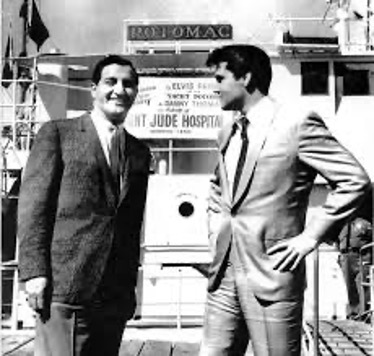
On Jan. 30, 1964, the Potomac was purchased by Elvis Presley.   He paid $55,000, in his words, to “keep it from winding up in a junk heap.”[6]  He intended giving it to The National Foundation-March of Dimes to become a national FDR monument and fund raiser.  Originally delighted but after more investigation into upkeep costs, they politely refused.   He looked for other takers including St. Jude Children’s Research Hospital in Memphis, Tennessee. She would be moved to Memphis and made into a floating restaurant.   A favorite charity, he planned to “hand over the keys” on Feb. 3, 1964, to Danny Thomas, founder and key-fund raiser for St. Jude’s.    On the handover day, he joined with Danny Thomas and his “Memphis Mafia” on the Potomac deck for speeches, photographs, and autographs. 

After the ceremony, the hospital became aware of the costs involved in ownership and relocation and decided to stay in the “hospital business” not the “boat business.”  Presley’s contributions included $8,000 to paint one side (shoreside) for the press conference. 

Elvis’ attorneys arranged for a second sale this time from St. Jude’s to Marie Pagliasso.  She was the heir to the estate of “Dutch” Leonard, a former pitcher for the Boston Red Sox and fan of the Roosevelts.  She formed a group that obtained a bank loan with a third-party guarantee to purchase her for $62,500.  The ship’s decline was about to accelerate.

 For several years she led the restoration effort, but the “group” fell apart and a lawsuit over ownership ensued.  The Potomac was put up for sale again on Sept. 13, 1966.  This time she was berthed at Marina Del Ray, Los Angeles.  No acceptable bids were received, and she retained ownership in failing health, not making payments until her death in 1970 when ownership transferred to Carton Taylor, the man who guaranteed the original loan.  He tried selling her with an advertisement in the Wall Street Journal in 1970 but ended up making a “verbal agreement” to lease her to Aubrey Phillips, a commercial fisherman, private investigator, and Long Beach bail bondsman who seemed “…like a terrific, nice guy[7].” 

Phillips moved her to Portofino in Redondo Beach.   Once more she sat, deteriorating.  Over the years, we find her berthed at different southern California harbors until February 1979 when she was towed from Los Angeles to Stockton.

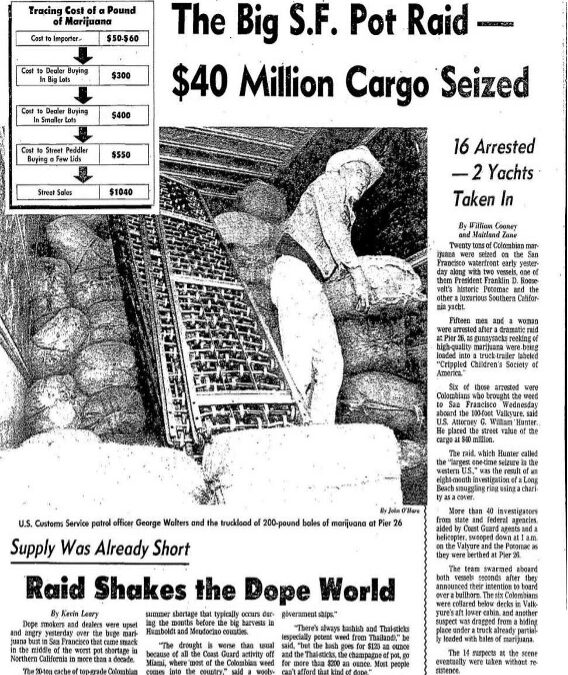
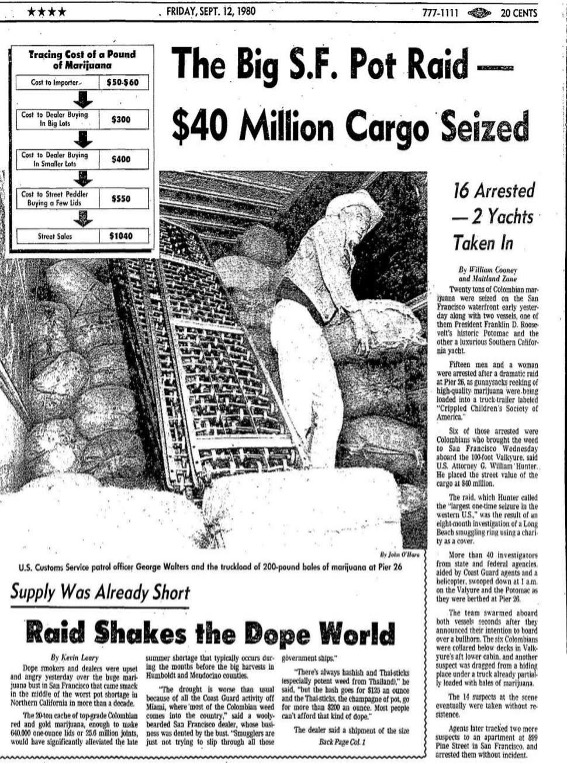
 In August 1980, Phillips moved the Potomac to Pier 26 in San Francisco, allegedly for repairs.   She was joined on Sept. 10 by the Valkyure, an 85-footer, overloaded with 21-tons[8] of Columbian marijuana worth $40 million[9] on board.  Both vessels flew the black and yellow flag of the Crippled Children’s Society of America, a bogus charity. In the early morning hours of Sept. 11, offloading the marijuana began from the Valkyure to a waiting truck also draped with the Crippled Children’s Society flag.   At 1 a.m., a U.S. Coast Guard helicopter lighted the scene for what U.S. Attorney G. William Hunter[10] characterized as “the largest one-time seizure in the Western U.S.”  The Potomac was not carrying any marijuana but along with the Valkyure was “arrested”[11] for being part of the illegal activity.

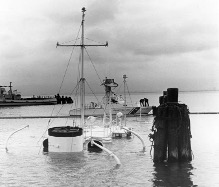
Now “busted” the former law enforcing Electra was moored and “arrested” at Treasure Island in San Francisco Bay under federal custody.  Six months later on March 18, 1981, while in federal custody, the USS Potomac’s hull was holed by broken pilings, and she sank at her Treasure Island berth in thirty-five feet of water.  

The Potomac had reached the lowest point in her career.  It had to be raised!


After it was decided in federal court that the ship had been forfeited, it was purchased on April 21, 1981, by the Port of Oakland in public auction.  Their winning (and only) bid was $15,000.

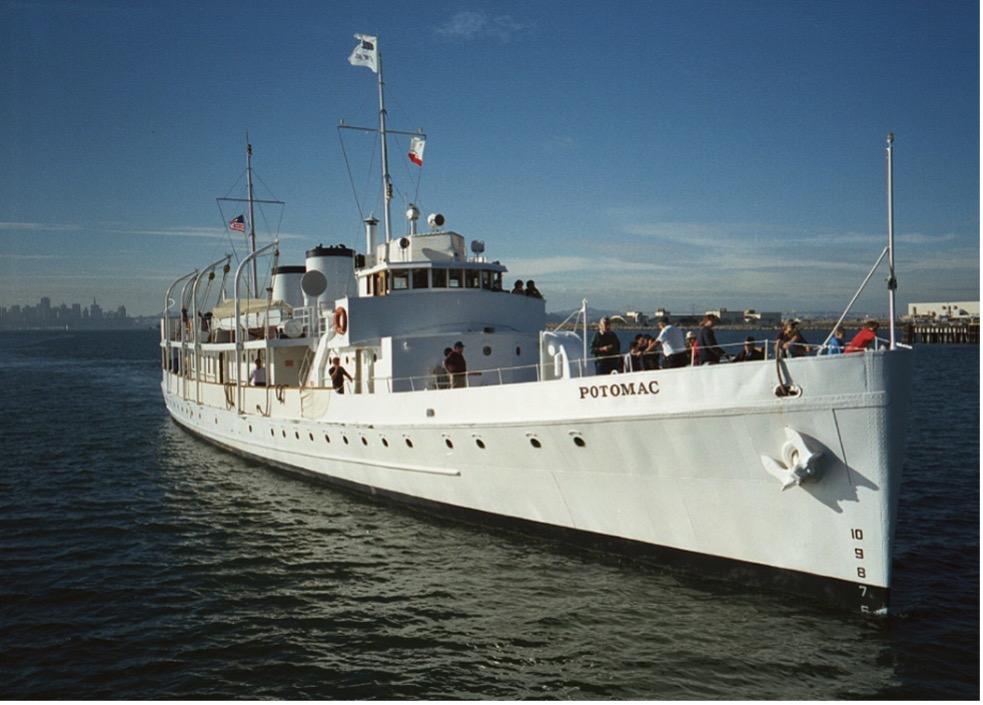
The Association for the Preservation of the Presidential Yacht Potomac, a non-profit organization, was created to lead the restoration effort working with the Port.   After raising more than $5 million in private and government funding, the USS Potomac was fully restored and started public operations on May 20, 1995.  

Today she is the oldest Navy ship (decommissioned) still in daily operation and the only nationally recognized memorial to FDR in the western states.

Alcohol and marijuana were the bookends of her earlier life both now legal where launched  and seized.


[1] “Rum War at Sea” by Malcolm F. Willoughby, Commander USCGR(T)

[2] “The War on Alcohol” by Lisa McGirr

[3]“ The Presidential Yacht Potomac” by Capt. Walter W. Jaffee

[4] See USS Potomac mini-histories …  “FDR Texas Fishing Trip” and “Florida Fishing Trip”

[5] “No Ordinary Time” by Doris Kearns Goodwin

[6]“ The Presidential Yacht Potomac” by Capt. Walter W. Jaffee

[7] Aubrey Phillips would later be sentenced to thirty months in federal prison for his role in drug smuggling involving the Potomac.

[8] 25.6 million joints

[9] Later valued at $250,000 in court documents

[10] G. William Hunter later was appointed to the Oakland Board of Port Commissioners, the next owner of the USS Potomac

[11] Under maritime law a ship can be arrested and treated as it if were a person

Harry Hopkins Onboard with FDR

Harry Hopkins Onboard with FDR

Personal Advisor to FDR for the Great Depression and World War II

(1912 Class President Grinnell College)


Next after FDR and his “little dog Fala,” the USS Potomac passenger with the most nautical miles was likely Harry L. Hopkins, the president’s valued advisor and closest companion during the war years.  He was frequently with FDR on the ship for cruises, fishing trips, and strategy sessions.

Harry had joined the Roosevelt administration when the President was governor of New York managing his welfare outreach.  He continued as head of the Works Progress Administration (WPA) to implement FDR’s New Deal.  He served as Secretary of the Interior during Roosevelt’s second administration.

He had lost a large part of his stomach to cancer which severely restricted his intake of vital nutrients rendering him frequently at “death’s door” needing emergency restoration at the Bethesda Naval Hospital or the Mayo Clinic.   After blood transfusions, other treatments and rest, he would be medically revived for “one more” assignment including matching cigarette to cigar and drink for drink in late night sessions with Winston Churchill.[1]
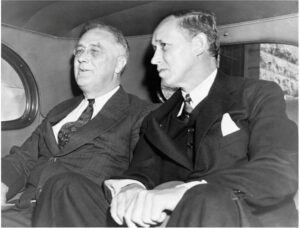
FDR with Harry Hopkins 1938

During the war years he became FDR’s “eyes and ears” and man on the ground for managing the military strategy and the personal relationships with British Prime Minister Winston Churchill and Soviet Premier Joseph Stalin.   On May 9, 1940, Hitler launched his attack on the Low Countries and France.  Winston Churchill became the Prime Minister of Great Britain.  Hopkins was with FDR the next day in the White House.  The President noticed how sallow and miserable Hopkins looked and ask him to “Stay the night.”   Harry borrowed some pajamas and settled in the Lincoln Suite[2], two doors down from FDR’s bedroom.   There he remained not for one night but for the next three and a half years.  Without an office or official government position, he transitioned from FDR’s number one New Deal relief worker to become his number one adviser on the war.

Hitler’s next target was Great Britain.  At the time, the smart money including U.S. Ambassador to Great Britain Joseph Kennedy, father of President John F. Kennedy, and military experts were predicting Churchill’s forces would not be able to hold.

FDR had a dilemma.  The country was largely anti-war and isolationist.  His second term in office was coming to an end.  America’s own defenses were in sorry shape. War was coming our way.  He internalized that his leadership was critical to America becoming the “Arsenal of Democracy” for its allies and to prepare for the country’s own defense.

He decided to seek an unprecedented third term if he could engineer to be “spontaneously” drafted at the Democrat National Convention scheduled for July in Chicago.  Retreating again to the Potomac for a two-day cruise with his political advisors to plan how to run when not running.  His strategy worked (see the USS Potomac Mini-History “FDR’s Run for a Third Term”).  He was nominated by the Democrats in Chicago and on Nov. 5, 1940, Franklin D. Roosevelt defeated Wendell Willkie for an unprecedented and never to be duplicated third term with 54.7% of the popular vote.

Now he had to prepare the country for the very war he had disavowed during the campaign.  He needed to find a way to get armaments and supplies to a financially stressed Great Britain without the reimbursement required by the “Neutrality Act.”  To lend not sell the materials was FDR’s plan.

A sense of doom pervaded Washington and London.   Almost everywhere the British were forced into the defensive.  German General Erwin Rommel was dominating in Egypt.  Hitler’s U-boat wolf packs were sinking hundreds of merchant ships in the North Atlantic.  Shipyards and port facilities in England were constantly pounded by massive air attacks.  The war as a whole was slipping away.  The survival of civilization seemed in Jeopardy.[3]

Should FDR even lend to Great Britain?  Lending and then losing armaments to a victorious Germany would threaten our own security.  The President wanted to assess Great Britain’s odds of surviving the Nazi assault.   Most importantly, he needed to establish a personal relationship with Winston Churchill.  He had met Churchill only once before when he was Assistant Secreatary of the Navy under Woodrow Wilson.  Churchill at first did not recall the meeting to FDR’s irritation.

The President sent Harry Hopkins on a two-week trip in January 1941 to meet with Churchill and assess the overall situation in Great Britain including its strength to resist the Nazi attack.  To Churchill, Hopkins was the country’s most important visitor in his lifetime.  Two weeks stretched to almost five including three weekends with Churchill and family at bone-cold Chequers, his country home, and a personal lunch with the King and Queen[4].   While Harry was assessing Great Britain’s needs, the critical Lend Lease legislation was approved by the House over strong opposition by Charles Lindberg and other isolationists.   Churchill then declared to a joint British American radio audience, “Give us the tools and we will finish the job.”  FDR and Harry knew Lend Lease was critical to saving Great Britain but not sufficient to “finish the job.”

Before returning, Harry set the stage for a later personal meeting between the two heads of state, where the USS Potomac would play another historic role.
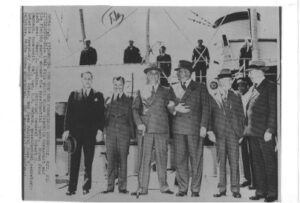
FDR and guests before boarding USS Potomac for 1941 Florida Fishing Trip (Hopkins left)

After Harry returned and the New Deal legislation was approved by Congress, FDR took a much-needed break in March …. a 10-day Florida fishing trip on the USS Potomac.  The President’s stress level was high.   He was beginning his unprecedented third term after campaigning on the promise to avoid war “…your boys are not going to be sent to any foreign wars.”  But he had to prepare for war whether the voters were ready or not.  FDR’s guests included Harry and his occasional critic Harold L. Ickes, Secretary of the Interior and Attorney General Robert H. Jackson.[5]  It was speculated that FDR thought a few days of relaxation together on the ship might help to mend the relationship between Hopkins and Ickes.  History does not record that it worked.  Ickes had criticized that Hopkins jobs created were not long term.  Harry had replied that people don’t eat long term.

The first lend lease appropriation of $7 billion had just passed Congress a week earlier and was signed by the President while on the Potomac.  He presented Harry with the signature pen and also a letter dated March 27, 1941, appointing him “to advise and assist the President in carrying out the responsibilities placed upon him by lend lease at an annually salary of $10,000.”  It was not as good as the $12,000 Harry made as Secretary of Interior in 1940 but better than no salary received for his “volunteer” assignments to that date.  He would run Lend Lease out of his Lincoln Suite in the White House.

Harry got in a little trouble with the Boss on the trip when the Potomac was at berth in Ft. Lauderdale because of high winds.  He showed up with Attorney General Jackson and Press Secretary Steve Early dressed to go out on the town in Miami after dinner.  FDR jumped on him like an angry father saying he was there for rest and that he would never take him on another trip if he went out.  Harry went to bed early that night.

As Lend Lease was starting up, the customer base doubled.  On June 21, 1941, Hitler turned east and invaded Russia “Operation Barbarossa” on an 1,800-mile front with three million German troops.  It was doubtful Russia could hold out.

In July, FDR decided Harry needed to go back to London for more meetings with Churchill to discuss the Lend Lease needs and convoy protection.  He was instructed not to discuss the U.S. entering the war.   He was also tasked with arranging the time and place of a shipboard meeting between the president and Churchill.  On July 17, 1941, Harry met again with Churchill, this time as friends, at No. 10 Downing Street.  Harry explained that the President wanted to meet him during the second week of August in “some lonely bay or other.”  Placentia Bay in Newfoundland was chosen, the date of August 9 was fixed, and Churchill placed his newest battleship, The Prince of Wales[6], under orders accordingly.[7]

Busy with lend lease and war strategy issues, Harry found time to weekend with Churchill at Chequers complete with Cuban cigars, drinks, and late-night conversations.  While there he met for the first time Ivan Maisky, the Soviet Ambassador to Great Britain, who was convinced that Hopkins was dead serious about helping the Soviet Union.   The Germans had captured Smolensk, Russia’s oldest city, and were threatening to encircle Leningrad (now St. Petersburg).  When Hopkins asked what supplies were needed, the ambassador suggested he visit Moscow to get the information.  Hopkins cabled the President for approval which was received back in hours.  Churchill immediately scheduled the travel arrangements so that Hopkins would be back in time to join Churchill on the HMS Prince of Wales for their forthcoming shipboard meetings with President Roosevelt in Newfoundland.

Harry arrived in Russia with a personal note from FDR to Stalin reading, “Treat Mr. Hopkins with the identical confidence you would feel if you were talking to me.”   On the evening of July 30, 1941, Hopkins, accompanied by the U.S. Ambassador and an interpreter, met with Marshall Stalin in his Kremlin office.  He accepted Stalin’s offer of a cigarette and reciprocated with a Camel having been told it was the marshal’s favorite brand.  They got to business quickly identifying Russia’s needs.  Stalin laid it all out.  The next evening, they met a second and final time but with just Hopkins and Stalin and his interpreter.  Stalin provided an assessment of the war situation, probably optimistic, for Hopkins to advise FDR.  The meeting ended after almost four hours.  Hopkins was convinced this was a fight to the death.

The trip to Russia brought Hopkins close to death another time.  He forgot his medications when he left Moscow, arriving in Scotland boarding the Prince of Wales in a state of near collapse needing a blood transfusion and bedrest.   Two days later the great battleship with Churchill, his entourage[8] and a reviving Hopkins would start the dangerous journey across the North Atlantic to meet President Roosevelt in Newfoundland.

In Washington, FDR announced plans for a 10-day fishing trip on the USS Potomac off the coast of New England[9].  On this trip, the fish would be spared.  He left Washington by train on August 3 to New London, Connecticut, where he transferred in front of thousands to the presidential yacht.  After being observed by the public and press in the New England waters, FDR transferred in secret with Fala to the Cruiser USS Augusta.  The Potomac still flying his flag cruised the Cape Cod Canal for public consumption with a suitably dressed imposter complete with tilted cigarette-holder fishing over the side.

On August 8, President Roosevelt watched from the USS Augusta at anchor in Placentia Bay, Newfoundland, the arrival of Churchill’s party including Hopkins (and probably Rufus) on the HMS Prince of Wales.  Meetings, including the war planners, continued back forth for four days on the two ships.  Roosevelt and Churchill worked on a draft document signed separately that became known as the “Atlantic Charter.”  It set forth the vision and principles of the post war world and became the foundation for the United Nations.

Harry had transferred back to the American side with FDR and Fala when the Augusta reconnected with the Potomac. To allow safe passage time for Churchill to get back to Great Britain, they took their time coming back to resurface publicly on the presidential yacht.

Back on the Potomac, FDR held a shipboard press conference on August 16, including Hopkins, in Rockford, Maine.  Mindful of the country’s still isolationist mood, FDR downplayed the meeting which had included the top military planners of both governments and emphasized instead a “…very remarkable religious service.”  The Atlantic Charter statement was “…an exchange of views, that’s all.  nothing else.”  To the reporter who asked if America was closer to war.  Roosevelt replied, “I should say, no.”

The Japanese answered differently on December 7, 1941, and Hitler settled the question four days later by declaring war on the United States.

Harry Hopkins would remain at FDR’s side for the duration of the war joining him for all the offshore war conferences applying his unique personal relationships with the three leaders, FDR, Churchill and Stalin.

They were just once more on the USS Potomac, another secret assignment for the presidential yacht[10].  The Potomac had transferred to Quantico Marine Base in Virginia on Nov. 11, 1943.  The President with a small party including Harry left the White House for Quantico in secret after dark to board the ship and cast off immediately down the river toward the Chesapeake Bay.  Anchoring overnight in the river, the president and his party transferred to the USS Iowa the next morning for the next stage of a 17,442-mile trip that included the Tehran war conference where Roosevelt, Churchill and Stalin met for the first time.  Hopkins was the single individual who had connected personally with all three leaders.  At the conference Stalin made a rare point of displaying his personal consideration for Harry who despite his ill health had made the exhausting and hazardous journey to Moscow in 1941, to help the besieged Russian people.  The big three agreed to the date for Operation Overlord, and with Harry’s personal touch overcoming Churchill’s long-standing resistance to the Normandy Invasion.  On Dec. 16, 1943, the Iowa returned the President and Harry to the presidential yacht for an overnight on board before the final leg home to Washington the next morning.  This was their last trip on the USS Potomac.

The Potomac was not involved in the next war conference in Yalta, but Harry was.  Returning home with FDR on the USS Quincy after the meetings, Harry was too sick to continue and disembarked at Algiers on February 18, 1945, leaving the president to continue home without him.   The two would never see one another again.

Franklin Roosevelt died on April 12, 1945, at Warm Springs.

Hopkins immediately became President Truman’s source for all-things Roosevelt and to prepare the new president for the forthcoming final war conference at Potsdam.  Post war relationships with the Soviet Union started to fray.  In May 1945, Hopkins managed a final visit, this time for Truman, to meet again with Stalin (six separate sessions).  But his contact with life was growing slender, as Churchill said about Roosevelt.  The end came on January 29, 1946, with Harry L. Hopkins saying “You can’t beat destiny” before slipping into a coma.  He was 55-years old[11].


[1] Winston Churchill re Harry Hopkins “His was a soul that flamed out of frail and failing body.”  Source:  “The Hopkings Touch” by David L. Roll

[2] The Blue Room – Lincoln Study where the Emancipation Proclamation was signed.

[3] Source:  “The Hopkins Touch” by David L. Roll

[4] Harry Hopkins had been on board the USS Potomac with King George VI and Queen Mary for the1939  luncheon cruise to Mount Vernon

[5] Robert H. Jackson is the only American to serve as Solicitor General, Attorney General and U.S. Supreme Court Justice.   He also was the chief U.S. prosecutor in the Nuremberg German War Criminals trial.

[6] HMS Prince of Wales was sunk by Japanese bombers on Dec. 10, 1941, while returning to Singapore with the loss of 327 sailors.  The wreck is nearly upside down on the bottom off Kuantan, Malaysia.  The site has been designated as a ‘Protected Place, under the British Protection of Military Remains Act 1986.

[7] Source:”The Hopkins Touch” by David L. Roll

[8] Some records show that Churchill’s entourage included Rufus, his pet poodle.   FDR’s entourage definitely included Fala, his Scottie.


[9] See USS Potomac Mini-History “Atlantic Conference with Winston Churchill – August 1941”\

[10] See USS Potomac mini-history “USS Potomac’s Role in President Roosevelt’s Tehran Conference”

[11] Source:  “The Hopkins Touch” by David L. Roll

Founding the United Nations in San Francisco

Founding the United Nations in San Francisco

Founding the United Nations in San Francisco

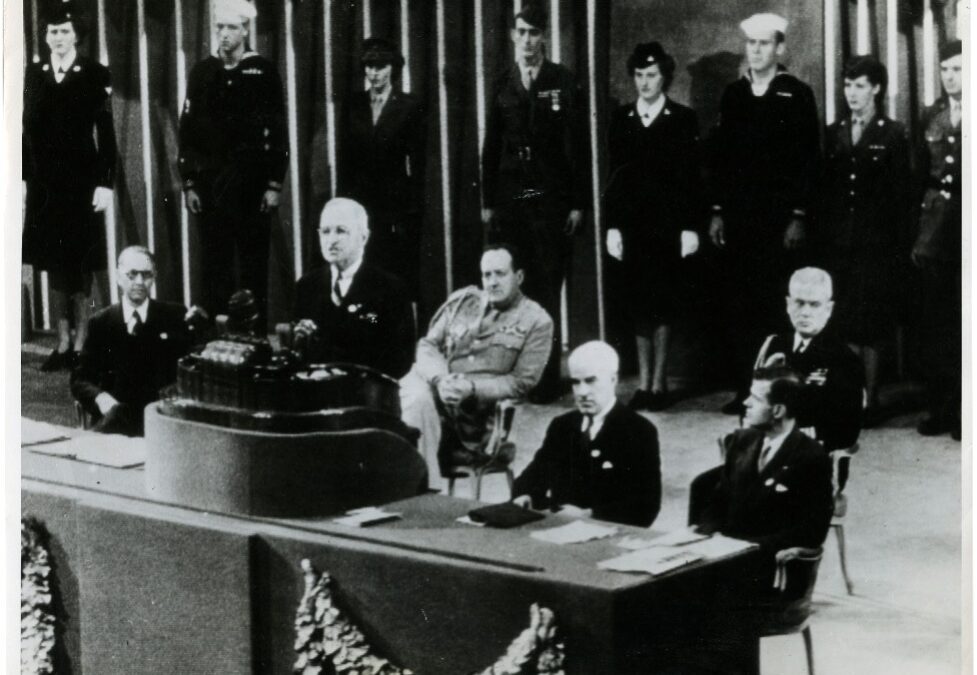
President Harry Truman at UN Closing Ceremony

Eighty years ago on June 25, 1945, the Charter of the United Nations was adopted unanimously in the San Francisco Opera House and signed the following day at Herbst Theatre Auditorium in the Veterans War Memorial Building.  There had been 51 days of debate with the outcome often on life-support.

There were 850 delegates at the Conference, and their advisers and staff brought the total to 3,500.  In addition, there were more than 2,500 press, radio and newsreel representatives and observers from many societies and organizations.  In all, the San Francisco Conference was not only one of the most important in history but, perhaps, the largest ever international conference.

President Franklin Roosevelt intended to make the opening and closing speeches.  He had returned exhausted from the February 4 – 11, 1945, Yalta Conference with Prime Minister Winston Churchill and Soviet Marshall Joseph Stalin.  They had discussed post war world order, tried to diagnose Russia’s true intentions for Poland and considered in secret the voting procedures for the forthcoming San Francisco conference.   FDR joked that it might be a mistake to speak at the opening in the event the conference failed.   Probably thinking about the secret atomic bomb project, he asked his speech writer Robert Sherwood to refer to the increasing importance of science in resolving the problems of a future world.[1]

President Franklin D. Roosevelt died on April 12, 1945, in Warm Springs, Georgia.  The delegates in San Francisco did not get to hear him say, “…we must cultivate the science of human relationships—the ability of all peoples, of all kinds, to live together and work together in the same world, at peace.”

FDR had been the driving force behind the United Nations starting in August 1941 with what became known as the Atlantic Charter   Using the USS Potomac as a decoy for a publicly announced fishing trip, FDR (and his dog Fala) transferred in secret to the Cruiser USS Augusta off Cape Cod.  FDR was off for the secret rendezvous with Churchill.[2]  The Potomac still flying his flag cruised the Cape Cod Canal for public consumption with a suitably dressed FDR imposter complete with a rakish tilted cigarette-holder fishing over the side.

For Roosevelt, it was clear that some form of joint declaration should come out of his secret meeting with Churchill.  He pressed Churchill to jointly define the concept of what should become a new post war world order.  After several drafts, the first offered by Churchill, the two leaders agreed on an eight-point statement “…to make known certain common principles in the national policies of their respective countries on which they base their hopes for a better future for the world.”   Released but never jointly signed, it set forth the foundational principles for the United Nations as formed in San Francisco four years later.[3]

Back on the USS Potomac after Churchill had returned home and the joint declaration had been released, FDR held an on-board press conference including Harry Hopkins (and Fala) in Rockford, Maine.  Mindful of the country’s still isolationist mood, FDR downplayed the meeting with Churchill and their joint declaration.  Instead, he described the Atlantic Charter statement as “…an exchange of views, that’s all, nothing else.”  German Propaganda Minister Joseph Goebbels in an article released to the entire German press described the Roosevelt-Churchill joint declaration as “an outrage against common sense.”  Further, he added, “Seldom has history seen such a stupid, unimaginative document as the two big guns of world plutocracy framed on the Potomac.”  History thought otherwise in San Francisco when the Charter of the United Nations was adopted based on its principles on June 25, 1945.

To the reporter who asked if America was closer to war.  Roosevelt replied, “I should say, no.”  The Japanese answered differently on December 7, 1941, and Hitler settled the question four days later by declaring war on the United States.

It was Harry S. Truman not Franklin Roosevelt who opened the San Francisco conference.  Truman had been Vice President for 82-days.  He had met with FDR only twice, except for cabinet meetings.  He was not aware of the Manhattan project to develop the atomic bomb or the plans for the San Francisco conference as discussed with Churchill and Stalin at the just completed Yalta Conference.


His first act as President was to approve going forward with the San Francisco conference as scheduled.  He addressed the delegation by radio hookup not in person on April 25, 1945, thirteen days after assuming the presidency. His radio-delivered remarks were critiqued as a poor speech with “windy, mostly meaningless pronouncements,” not the direct talk that became his later style.

The conference outcome was uncertain.  Participation was extended to the countries that had allied in the war against Germany and Japan.   Some attendees were questionable.  Argentina was suspect.  The country had hurriedly declared war against Germany to get in on the meeting and the Soviets suspected she harbored fascist sympathies.  Denmark was still occupied by the Nazis with no exile government.   Control of Poland was in flux.  Unknown to the smaller countries, the Big Three at Yalta had already agreed to certain foundational principles including veto power for the permanent members.  Also, at Yalta, Churchill and FDR had agreed to separate membership (and more votes) for Soviet republics of Ukraine and White Russia.

Roosevelt’s Atlantic Charter post war dream was in jeopardy if his wartime Soviet partner lost interest.  Truman was at a severe disadvantage.  He had no exposure to Stalin or the personal processes that led to the Yalta Big Three decisions before the San Francisco Conference.  He turned to the only man in the United States with those keys, Harry Hopkins, FDR’s closest war time aide who had been at the President’s side for all the offshore war time conferences.  Harry also was probably the USS Potomac’s most frequent traveler, after FDR (and Fala).

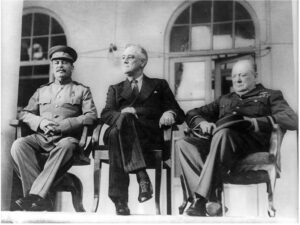
Big 3 at Yalta Conference

Hopkins had been with FDR at Yalta and knew all the details and secret agreements with Stalin concerning the forthcoming San Francisco Conference.  To FDR’s irritation, Harry claimed he was too ill to join him for the homeward journey from Yalta on the USS Quincy.   They would never see each other again.  When Harry got home, he headed straight for the Mayo Clinic only leaving when Roosevelt died.  While the former president’s casket rested on a bier in the White House East Room, Truman first met with Hopkins in FDR’s barren oval office to learn about how to deal with Stalin.

When Stalin learned of President Roosevelt’s death, he said he wanted to give assurance to the American people of his continuing cooperation.  Our Ambassador Averill Harriman said the American people would appreciate him sending his foreign minister Molotov to the forthcoming San Francisco Conference.  Molotov was reluctant.  Stalin said he was prepared to tell Molotov to go if requested by President Truman who immediately sent a cable invitation[4].  Molotov started packing.

Even with the Big Three foreign ministers in San Francisco, the conference discussions were stalled in large part about voting procedures in the security council.  Molotov boycotted and headed home.  The problems at the San Francisco Conference were symptomatic of broader issues in the American and Soviet relationship now without FDR’s leadership.

President Truman called Harry Hopkins, who despite his health, agreed to meet with Stalin in Moscow.  If there was a key to gaining improved Soviet cooperation, it was Hopkins, the only American with a personal relationship and Stalin’s respect.  In Moscow, Hopkins had six separate and long meetings with Stalin going over a range of issues troubling the relationship between the two wartime partners.  Each meeting was followed by a detailed cable report from Hopkins to President Truman.   At the sixth and final meeting on June 6, Hopkins raised the issue that had led to the impasse at the San Francisco Conference …. the Soviet insistence that nothing could be discussed by the security council without unanimous vote of the permanent members.  Hopkins suggested there was a misunderstanding not a substance issue.  The U.S. supported unanimity for enforcement but not for discussion.  After more explanation and discussion, Marshall Stalin said he was prepared to accept the American position.  Hopkins cabled the news to Truman.  The San Francisco Conference had been saved.[5]

President Truman flew to San Francisco on The Sacred Cow (a Douglas VC-54C Skymaster and the first aircraft purpose built to fly the President of the United States) to speak in the Opera House at the official signing of the United Nations Charter.  He told the delegates to keep the world at peace.  “And free from the fear of war,” he declared emphatically, both hands chopping the air, palms inward, in rhythm with the words, “free,” “fear,” and “war.”  San Francisco was his first public appearance since becoming President, and the reception the City gave him took his breath away.   It was said that a million people turned out to cheer him as he rode in an open car.[6]

The Charter of the United Nations was adopted unanimously in San Francisco on June 25, 1945.

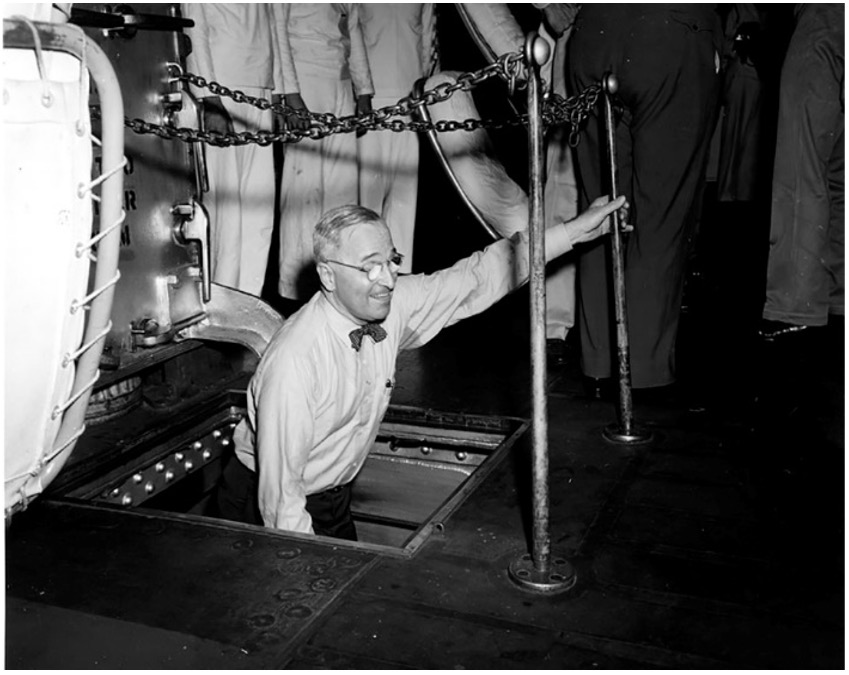
After his first public trip to San Francisco, President Truman like FDR before him, boarded the USS Potomac to both relax and plan.  In his case it was on July 4, 1945, to prepare for the first war time conference without Roosevelt scheduled in Potsdam, Germany.  President Truman’s notes from the Potomac read that he needed to decide the Japanese strategy… whether to “bomb” or ”blockade.”

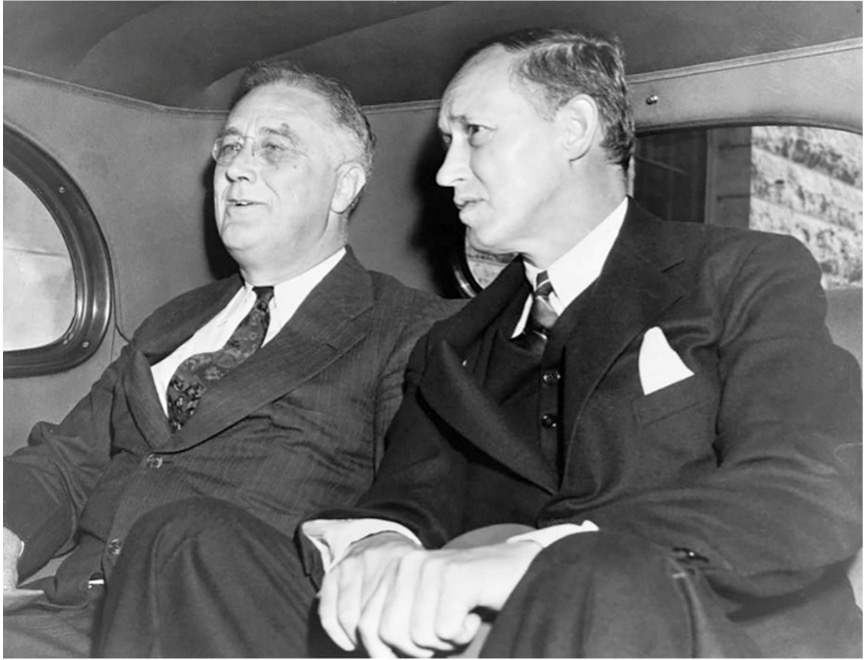
President Harry S. Truman on board USS Potomac 1945

Four months after the San Francisco Conference ended, the United Nations officially began, on October 24, 1945, after its charter had been ratified by China, France, the Soviet Union, the United Kingdom, the United States and by a majority of the other signatories.

In early December 1945, President Truman telephoned Eleanor Roosevelt to ask if she would be willing to serve as an American delegate to the first meeting of the United Nations General Assembly scheduled to open in London in January.  She said she wasn’t qualified and could not accept.  Truman refused to be put off.  He urged her to think about it.  She did.  She considered the United Nations to be the greatest of her husband’s legacies, and she longed for the job, but was terrified of failure.   With what she described as “fear and trembling,” she accepted the position, setting forth on a new journey into the field of universal human rights that would make her “the most admired person in the world” – an important figure in American life for nearly two more decades[7].


EXHIBIT 1

The Atlantic Charter

The President of THE UNITED STATES OF AMERICA, and the Prime Minister, Mr. Churchill, representing His Majesty’s GOVERNMENT IN THE UNITED KINGDOM, being met together, deem it right to make known certain common principles in the national policies of their respective countries on which they base their hopes for a better future for the world.

  1. Their counties seek no aggrandizement, territorial or otherwise.
  2. They desire to see no territorial changes that do not accord with the freely expessed wishes of the peoples concerned.
  3. They respect the right of all peoples to choose the form of government under which they will live, and they wish to see sovereign rights restored to those who have been forcibly deprived of them.
  4. They will endeavor, with due respect for their existing obligations, to further the enjoyment by all States, great or small, victor or vanquished, of access, on equal terms, to the trade and the raw materials of the world which are needed for their economic prosperity.
  5. They desire to bring about the fullest collaboration between all nations in the economic field with the object of securing for all, improved labor standards, economic advancement and social security.
  6. After the final destruction of the Nazi tyranny, they hope to see established a peace which will afford to all nations the means of dwelling in safety within their own boundaries, and which will afford assurance that all the men in all the lands may live out their lives in freedom from fear and want.
  7. Such a peace should enable all men to traverse the high seas and oceans without hindrance.
  8. They believe that all of the nations of the world, for realistic as well as spiritual reasons, must come to the abandonment of the use of force. Since no future peace can be maintained if land, sea or air armaments continue to be employed by nations which threaten, or may threaten, aggression outside of their frontiers, they believe, pending the establishment of a wider and permanent system of general security, that the disarmament of such nations is essential.  They will likewise aid and encourage all other practicable measures which will lighten for peace-loving peoples the crushing burden of armaments.

Franklin D. Roosevelt

Winston S. Churchill

August 14, 1941


[1] Source: “Roosevelt and Hopkins an Intimate History” by Robert E. Sherwood

[2] Some sources say Churchill was joined by his pet poodle Rufus.

[3] Source:  “Roosevelt and Churchill – The Atlantic Charter” by Michael Kluger & Richard Evans

[4] Source: “Roosevelt and Hopkins an Intimate History” by Robert E. Sherwood

[5] Source: “Roosevelt and Hopkins an Intimate History” by Robert E. Sherwood

[6] Source:  Truman” by David McCullough

[7] Source: “No Ordinary Time” by Doris Kearns Goodwin

Henry J. Kaiser, FDR’s Dynamo

Henry J. Kaiser, FDR’s Dynamo

Henry J. Kaiser, FDR’s Dynamo

Sources: Freedom’s Forge:  How American Business  Produced Victory in World War II by Arthur Herman

Henry J. Kaiser was described as “a dynamo” by President Franklin D. Roosevelt.  Kaiser became the symbol of America as the “arsenal of democracy” being named in a 1945 Roper poll as the civilian most responsible for winning the war, right after Franklin Roosevelt himself.  He was generally regarded as the “miracle man.”

Before America entered the war, the President faced the challenge of arming America and providing existential support to an out-of-cash Great Britain when “cash and carry” was the legal requirement for American supplies.  He came up with “lend lease” approved by Congress on March 11, 1941, to eliminate the cash requirement.  The first lend lease appropriation was signed by FDR on his Presidential Yacht USS Potomac.

The free world needed ships and lots of them.  Nazi U-boats were sinking merchant ships three times faster than they could be replaced.  FDR turned to Kaiser who had started a shipbuilding contract with the British at his newly constructed shipyard in Richmond, California.  Also, Kaiser had constructed a shipyard in Portland, Oregon.  

His son Edgar managed the Portland yard and his “almost” son, Clay Bedford, managed Richmond.  Roosevelt had met them both.  The government fixed on Kaiser’s “liberty ship” as the standard design for the new American maritime cargo ships.  How fast could they be built was the challenge.  Henry encouraged the competition between the two yards.

FDR was on hand at Kaiser’s Portland yard on September 23,1942, to witness firsthand the delivery of the Liberty Ship Joseph Teal in a record 10-days, ninety percent faster than the pre-Kaiser shipbuilding era.  FDR met and congratulated Henry, Edgar and Clay Bedford.   With 14,000 workers and 6,000 on-lookers as witness, the President’s daughter officially launched the vessel with a third swing of the champagne bottle on the Teal’s bow.  Although constructed at unprecedented breakneck speed, Kaiser and FDR both knew the Teal’s 10-day record would not hold for long. 

Bedford was going to prove it.  Out of concern about downplaying the 10-day delivery just witnessed by the President, he shared a possible five-day delivery plan with his mentor Henry, who brought it to the attention of FDR.  The President said, “If it can be built in one day, so much the better.”

On Nov. 12,1941, the Liberty Ship Robert E. Peary was launched in four days, fifteen hours, and twenty-six minutes.  Six minutes later the blocks were cleared for the next hull to be constructed.  The record had been set and would hold as one of the supreme industrial feats of the war.  The Robert E. Peary showed no signs of being a “quickie.”  She would log more than 42,000 miles in both the Pacific and Atlantic theaters of operation and then as a cargo ship after the war, finally heading to the scrapyard in June 1963, after years in the reserve fleet.

FDR managed the war and his relationships with the key players like Henry J. Kaiser, often from the USS Potomac where he frequently both relaxed and planned during the pre-war period.  Today the Presidential Yacht is berthed in Oakland, Kaiser’s headquarters city.  There the ship keeps alive for current and future generations one of the most important eras of American history, the Great Depression, World War II, and the contributions of men like Henry Kaiser.

Kaiser executives played key leadership roles in the 14-year community effort to restore the ship after its 1981 purchase by the Port of Oakland.  James McCloud, retired president of Kaiser Engineers, guided the technical aspects of the restoration working almost daily on site and serving as a co-chairman of the Potomac Association board of governors.  Cornell C. Maier, chairman of Kaiser Aluminum and Chemical Corp, was co-chairman of the Potomac’s national find raising campaign.  Maier joined the delegation led by James Roosevelt, FDR’s oldest son, in a White House meeting with President Ronald Regan to advance the project.  James A. Vohs, former CEO and president of Kaiser Foundation Health Plan, has provided continuing advice and support through the restoration and the years of operation.

The USS Potomac is one of six recognized national memorials for Franklin D. Roosevelt and the only one west of the Mississippi River.   She is also the oldest (commissioned/decommissioned) U.S. Navy ship still in daily operation.