
Founding the United Nations in San Francisco
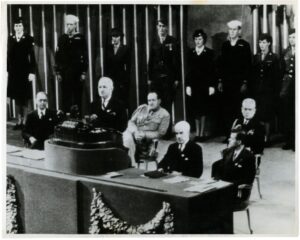
President Harry Truman at UN Closing Ceremony
There were 850 delegates at the Conference, and their advisers and staff brought the total to 3,500. In addition, there were more than 2,500 press, radio and newsreel representatives and observers from many societies and organizations. In all, the San Francisco Conference was not only one of the most important in history but, perhaps, the largest ever international conference.
President Franklin Roosevelt intended to make the opening and closing speeches. He had returned exhausted from the February 4 – 11, 1945, Yalta Conference with Prime Minister Winston Churchill and Soviet Marshall Joseph Stalin. They had discussed post war world order, tried to diagnose Russia’s true intentions for Poland and considered in secret the voting procedures for the forthcoming San Francisco conference. FDR joked that it might be a mistake to speak at the opening in the event the conference failed. Probably thinking about the secret atomic bomb project, he asked his speech writer Robert Sherwood to refer to the increasing importance of science in resolving the problems of a future world.[1]
President Franklin D. Roosevelt died on April 12, 1945, in Warm Springs, Georgia. The delegates in San Francisco did not get to hear him say, “…we must cultivate the science of human relationships—the ability of all peoples, of all kinds, to live together and work together in the same world, at peace.”
FDR had been the driving force behind the United Nations starting in August 1941 with what became known as the Atlantic Charter Using the USS Potomac as a decoy for a publicly announced fishing trip, FDR (and his dog Fala) transferred in secret to the Cruiser USS Augusta off Cape Cod. FDR was off for the secret rendezvous with Churchill.[2] The Potomac still flying his flag cruised the Cape Cod Canal for public consumption with a suitably dressed FDR imposter complete with a rakish tilted cigarette-holder fishing over the side.
For Roosevelt, it was clear that some form of joint declaration should come out of his secret meeting with Churchill. He pressed Churchill to jointly define the concept of what should become a new post war world order. After several drafts, the first offered by Churchill, the two leaders agreed on an eight-point statement “…to make known certain common principles in the national policies of their respective countries on which they base their hopes for a better future for the world.” Released but never jointly signed, it set forth the foundational principles for the United Nations as formed in San Francisco four years later.[3]
Back on the USS Potomac after Churchill had returned home and the joint declaration had been released, FDR held an on-board press conference including Harry Hopkins (and Fala) in Rockford, Maine. Mindful of the country’s still isolationist mood, FDR downplayed the meeting with Churchill and their joint declaration. Instead, he described the Atlantic Charter statement as “…an exchange of views, that’s all, nothing else.” German Propaganda Minister Joseph Goebbels in an article released to the entire German press described the Roosevelt-Churchill joint declaration as “an outrage against common sense.” Further, he added, “Seldom has history seen such a stupid, unimaginative document as the two big guns of world plutocracy framed on the Potomac.” History thought otherwise in San Francisco when the Charter of the United Nations was adopted based on its principles on June 25, 1945.
To the reporter who asked if America was closer to war. Roosevelt replied, “I should say, no.” The Japanese answered differently on December 7, 1941, and Hitler settled the question four days later by declaring war on the United States.
It was Harry S. Truman not Franklin Roosevelt who opened the San Francisco conference. Truman had been Vice President for 82-days. He had met with FDR only twice, except for cabinet meetings. He was not aware of the Manhattan project to develop the atomic bomb or the plans for the San Francisco conference as discussed with Churchill and Stalin at the just completed Yalta Conference.
His first act as President was to approve going forward with the San Francisco conference as scheduled. He addressed the delegation by radio hookup not in person on April 25, 1945, thirteen days after assuming the presidency. His radio-delivered remarks were critiqued as a poor speech with “windy, mostly meaningless pronouncements,” not the direct talk that became his later style.
The conference outcome was uncertain. Participation was extended to the countries that had allied in the war against Germany and Japan. Some attendees were questionable. Argentina was suspect. The country had hurriedly declared war against Germany to get in on the meeting and the Soviets suspected she harbored fascist sympathies. Denmark was still occupied by the Nazis with no exile government. Control of Poland was in flux. Unknown to the smaller countries, the Big Three at Yalta had already agreed to certain foundational principles including veto power for the permanent members. Also, at Yalta, Churchill and FDR had agreed to separate membership (and more votes) for Soviet republics of Ukraine and White Russia.
Roosevelt’s Atlantic Charter post war dream was in jeopardy if his wartime Soviet partner lost interest. Truman was at a severe disadvantage. He had no exposure to Stalin or the personal processes that led to the Yalta Big Three decisions before the San Francisco Conference. He turned to the only man in the United States with those keys, Harry Hopkins, FDR’s closest war time aide who had been at the President’s side for all the offshore war time conferences. Harry also was probably the USS Potomac’s most frequent traveler, after FDR (and Fala).
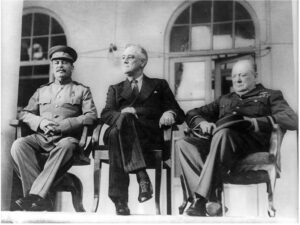
Big 3 at Yalta Conference
When Stalin learned of President Roosevelt’s death, he said he wanted to give assurance to the American people of his continuing cooperation. Our Ambassador Averill Harriman said the American people would appreciate him sending his foreign minister Molotov to the forthcoming San Francisco Conference. Molotov was reluctant. Stalin said he was prepared to tell Molotov to go if requested by President Truman who immediately sent a cable invitation[4]. Molotov started packing.
Even with the Big Three foreign ministers in San Francisco, the conference discussions were stalled in large part about voting procedures in the security council. Molotov boycotted and headed home. The problems at the San Francisco Conference were symptomatic of broader issues in the American and Soviet relationship now without FDR’s leadership.
President Truman called Harry Hopkins, who despite his health, agreed to meet with Stalin in Moscow. If there was a key to gaining improved Soviet cooperation, it was Hopkins, the only American with a personal relationship and Stalin’s respect. In Moscow, Hopkins had six separate and long meetings with Stalin going over a range of issues troubling the relationship between the two wartime partners. Each meeting was followed by a detailed cable report from Hopkins to President Truman. At the sixth and final meeting on June 6, Hopkins raised the issue that had led to the impasse at the San Francisco Conference …. the Soviet insistence that nothing could be discussed by the security council without unanimous vote of the permanent members. Hopkins suggested there was a misunderstanding not a substance issue. The U.S. supported unanimity for enforcement but not for discussion. After more explanation and discussion, Marshall Stalin said he was prepared to accept the American position. Hopkins cabled the news to Truman. The San Francisco Conference had been saved.[5]
President Truman flew to San Francisco on The Sacred Cow (a Douglas VC-54C Skymaster and the first aircraft purpose built to fly the President of the United States) to speak in the Opera House at the official signing of the United Nations Charter. He told the delegates to keep the world at peace. “And free from the fear of war,” he declared emphatically, both hands chopping the air, palms inward, in rhythm with the words, “free,” “fear,” and “war.” San Francisco was his first public appearance since becoming President, and the reception the City gave him took his breath away. It was said that a million people turned out to cheer him as he rode in an open car.[6]
The Charter of the United Nations was adopted unanimously in San Francisco on June 25, 1945.
After his first public trip to San Francisco, President Truman like FDR before him, boarded the USS Potomac to both relax and plan. In his case it was on July 4, 1945, to prepare for the first war time conference without Roosevelt scheduled in Potsdam, Germany. President Truman’s notes from the Potomac read that he needed to decide the Japanese strategy… whether to “bomb” or ”blockade.”
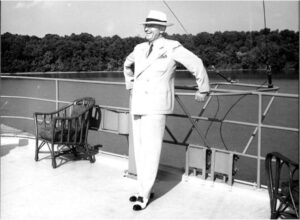
President Harry S. Truman on board USS Potomac 1945
Four months after the San Francisco Conference ended, the United Nations officially began, on October 24, 1945, after its charter had been ratified by China, France, the Soviet Union, the United Kingdom, the United States and by a majority of the other signatories.
In early December 1945, President Truman telephoned Eleanor Roosevelt to ask if she would be willing to serve as an American delegate to the first meeting of the United Nations General Assembly scheduled to open in London in January. She said she wasn’t qualified and could not accept. Truman refused to be put off. He urged her to think about it. She did. She considered the United Nations to be the greatest of her husband’s legacies, and she longed for the job, but was terrified of failure. With what she described as “fear and trembling,” she accepted the position, setting forth on a new journey into the field of universal human rights that would make her “the most admired person in the world” – an important figure in American life for nearly two more decades[7].
EXHIBIT 1
The Atlantic Charter
The President of THE UNITED STATES OF AMERICA, and the Prime Minister, Mr. Churchill, representing His Majesty’s GOVERNMENT IN THE UNITED KINGDOM, being met together, deem it right to make known certain common principles in the national policies of their respective countries on which they base their hopes for a better future for the world.
- Their counties seek no aggrandizement, territorial or otherwise.
- They desire to see no territorial changes that do not accord with the freely expessed wishes of the peoples concerned.
- They respect the right of all peoples to choose the form of government under which they will live, and they wish to see sovereign rights restored to those who have been forcibly deprived of them.
- They will endeavor, with due respect for their existing obligations, to further the enjoyment by all States, great or small, victor or vanquished, of access, on equal terms, to the trade and the raw materials of the world which are needed for their economic prosperity.
- They desire to bring about the fullest collaboration between all nations in the economic field with the object of securing for all, improved labor standards, economic advancement and social security.
- After the final destruction of the Nazi tyranny, they hope to see established a peace which will afford to all nations the means of dwelling in safety within their own boundaries, and which will afford assurance that all the men in all the lands may live out their lives in freedom from fear and want.
- Such a peace should enable all men to traverse the high seas and oceans without hindrance.
- They believe that all of the nations of the world, for realistic as well as spiritual reasons, must come to the abandonment of the use of force. Since no future peace can be maintained if land, sea or air armaments continue to be employed by nations which threaten, or may threaten, aggression outside of their frontiers, they believe, pending the establishment of a wider and permanent system of general security, that the disarmament of such nations is essential. They will likewise aid and encourage all other practicable measures which will lighten for peace-loving peoples the crushing burden of armaments.
Franklin D. Roosevelt
Winston S. Churchill
August 14, 1941
[1] Source: “Roosevelt and Hopkins an Intimate History” by Robert E. Sherwood
[2] Some sources say Churchill was joined by his pet poodle Rufus.
[3] Source: “Roosevelt and Churchill – The Atlantic Charter” by Michael Kluger & Richard Evans
[4] Source: “Roosevelt and Hopkins an Intimate History” by Robert E. Sherwood
[5] Source: “Roosevelt and Hopkins an Intimate History” by Robert E. Sherwood
[6] Source: Truman” by David McCullough
[7] Source: “No Ordinary Time” by Doris Kearns Goodwin