
Recent release of the bestselling book, “The Nazi Conspiracy, the Secret Plot to Kill Roosevelt, Stalin & Churchill,” reminds us of President Franklin Delano Roosevelt’s 1943 North Africa/Middle East trip including the first meeting with Winston Churchill and Joseph Stalin in Tehran. Earlier on this trip, FDR and Churchill met in Cairo with China President Chiang Kai-shek to discuss progress in the war with Japan and the future of Asia.
Little has been publicly recognized about the USS Potomac’s highly secret role in this trip to plan the final stages of World War II in both Asia and Europe.
Like its earlier role in 1941 as a decoy for his clandestine trip to meet with Winston Churchill for the Atlantic Conference off the coast of Newfoundland, again, the USS Potomac played a less recognized ruse role for the President’s get away. Secrecy was imperative. FDR was running grave personal risk in crossing the Atlantic for the conferences.
At noon, Nov. 11, 1943, the Potomac, commanded by Lieutenant Commander John H. Kevers, USN, cast off lines at Washington Navy Yard and departed for the Quantico, Virginia, marine base arriving in the early afternoon.
At 9:30 p.m., the President left the White House by automobile for Quantico. He was joined by Harry L. Hopkins, Admiral Willian D. Leahy, Rear Admirals Wilson Brown and Ross T McIntire, Major General Edwin M. Watson and Lieutenant George A. Fox. Other members of the President’s party had proceeded to Quantico earlier in the evening.
The utmost secrecy concerning the President’s proposed movements was observed. At Quantico, only the Commanding General and the Commanding Office of the Marine Base had knowledge of the President’s impending arrival.
At 10:38 p.m. the President and his party arrived at Quantico and immediately transferred to the Potomac for the first sea leg on the long journey for meetings first in Cairo and then in Tehran on Nov 28 to Dec. 1, 1943.
At 10:44 p.m., with the President and his party aboard, the Potomac cast off lines and set course down her namesake river for a rendezvous with the battleship USS Iowa[1] in the Chesapeake Bay near the confluence with the river. All members of the President’s party turned in soon after leaving Quantico. Strong winds earlier in the afternoon had abated to permit smooth sailing down the river. During the night, the Potomac exchanged calls with navy vessels bound up-river having transported the country’s senior military leadership and their baggage to the Iowa. In addition to the country’s top military brass, travelers boarding included the mess crew from the Potomac who would later prepare a grilled steak dinner for Stalin served with FDR’s prepared martinis (Stalin: “Well its all right, but it is cold on the stomach”).
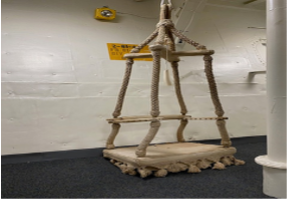 At 8:30 a.m. the next day, November 12, 1943, the Potomac got underway to go alongside the Iowa arriving to starboard, and at 8:51 a.m. the transfer of the party was begun using a special rig (see photograph of the special bosun’s chair built for the FDR transfers to/from the USS Potomac and the USS Iowa) from the after sundeck of the Potomac to the main deck of the Iowa, just abreast of the Iowa’s number three turret. This arrangement afforded a safe and comfortable means of transfer of the President who left the Potomac at 9:16 a.m. At his request, no honors were rendered when the President came on board the Iowa. Due to war-time restrictions, his flag was not broken on the Iowa.
At 9:45 a.m., the transfer of the party completed, the Potomac shoved off from alongside the Iowa and left for a secret destination with a vessel escort instructed to remain out of sight and incommunicado with the shore for a period of not less than one week. This was ordered to create the impression that the President might be on a cruise on the Potomac instead of at risk crossing the Atlantic.
In Tehran, the United States and Britain committed to launching the Normandy invasion of France in mid-1944. (Operation Overlord). Stalin agreed in principle to join the war against Japan in the Pacific after Germany was defeated. Tehran, the capital of Iran, had been chosen because it was protected by all three allied forces and was just a short run from Moscow, a condition for Stalin’s participation.
On Dec. 16 at 4:19 p.m., (low temperature of 23 degrees) the USS Iowa anchored off Cherry Point, VA to rendezvous again after 35 days with FDR’s yacht, USS Potomac, and two destroyer escorts. The Potomac came alongside and moored to the port side of the Iowa. At 5:19 p.m., FDR and his party left the USS Iowa and went on board the USS Potomac. The transfer was made by means of brow rigged in the same manner as when he boarded the battleship on Nov.12. No honors were rendered on FDR’s transfer back but the USS Potomac broke his flag at the main when he came on board.
At 5:26 p.m. the Potomac got underway from alongside the USS Iowa and proceeded up the Potomac River enroute to the Navy Yard, Washington D.C. escorted astern by the USS Booth. FDR worked on official mail as his presidential yacht headed to anchorage in the Potomac River just above Quantico, VA (Stump Neck). FDR had indicated that he did not desire to return to Washington, D.C. until 9 a.m. the next day.
On Dec. 17 at 6:00 a.m., the Potomac and USS Booth got underway from anchorage at Stump Neck for the Navy Yard, Washington, D.C. Small ice floes were encountered while the party proceeded up the river.
At 6:50 a.m., the two ships arrived at the Washington D.C Navy Yard. The Potomac was tied up. FDR was met by Eleanor Roosevelt and members of his immediate family who came on board the ship. He left the Potomac at 9:15 a.m. for a fifteen minute trip to the White House where he was met by a large delegation of his friends on hand to welcome him back home after a trip that had taken him 17,442 land, sea and air miles. He was greeted in the Diplomatic Reception Room by cabinet and members of congress (56).
[1] The USS Potomac and the USS Iowa are reported as the only two ships in the U.S. Navy with bathtubs which were added to accommodate the physical needs of their most senior shared passenger.
[i] There are many books and references related to FDR’s 1943 trip to North Africa and the Middle East but “As He Saw It,” a book by FDR’s son Elliott Roosevelt (and father of the USS Potomac Association Executive Director, Ford Roosevelt, with a foreword by Eleanor Roosevelt) provides a recommended insider and intimate view of many of the most sensitive meetings and events of this trip.