
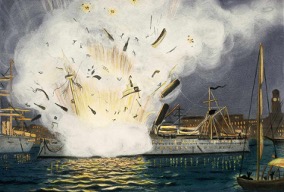
The Spanish-American conflict was a “splendid little war[1]” that marked America’s entry as an imperial power into world affairs. Coincidentally that same splendid little war was the origin of the USS Potomac’s all-Filipino mess crew and control of the White House mess by the U.S. Navy to this day.
It started in 1898 with the sinking of the USS Maine in Cuba by a mysterious explosion with the loss of 266 souls. The Maine was positioned in Havana Harbor to support Cubans against Spanish rule. Was it sabotage or an internal accident? There was little patience for an investigation by a public enraged by a barrage of media coverage[2] about Spain’s brutally repressive measures to halt a Cuban rebellion. Enough was enough. On April 25, 1898, The United States declared war on Spain including its possessions of Cuba, Puerto Rico, Guam and the Philippines with the slogan, “Remember the Maine.”
The Philippines had been under Spanish rule for 333 years. In a few hours on May 1, American Commodore Dewey destroyed the Spanish fleet and captured Manila’s harbor with only nine wounded. The U.S. sent ground forces to the conflict and captured the city of Manila. On December 10, 1898, the Spanish government ceded the Philippines to the United States in the Treaty of Paris. We were the new colonizer for the Filipinos to resist. American colonialization was for 48 years until the U.S. recognition of Philippine independence in 1946.
The USS Potomac would be a beneficiary of the U.S. new relationship with the Philippines. President William McKinley signed an executive order in 1901 allowing the Navy to enlist 500 Filipinos as part of the insular force. In a number of Philippine communities, joining the U.S. Navy became a tradition as well as a badge of distinction. Navy bases in the Philippines exposed local people to American wealth, culture and standards of living, generating strong incentive for investment. Most applicants were assigned to steward duties including on presidential yachts.
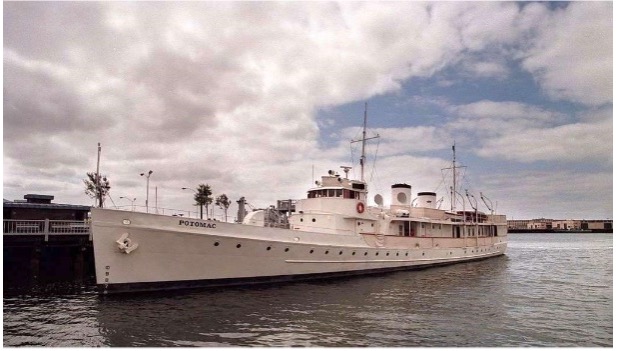
There is a history going back to President Rutherford Hayes in 1880 that navy stewards were first utilized to provide food services to the Commander-in-Chief on the Presidential Yacht Dispatch. The USS Potomac continued those traditions and had a mess crew of twelve, all Filipino U.S. naval personnel.
In 1942, FDR established a presidential retreat tucked away in the Maryland Catoctin mountains and named it “Shangri-La.”[3] FDR directed that his Potomac Navy stewards provide messing services at Shangri-La establishing the precedent of Navy personnel to serve the President and his staff ashore. With the Potomac Filipino mess crew coming ashore, the tradition was established for the U.S. Navy’s continuous and current operation of the White House Mess.
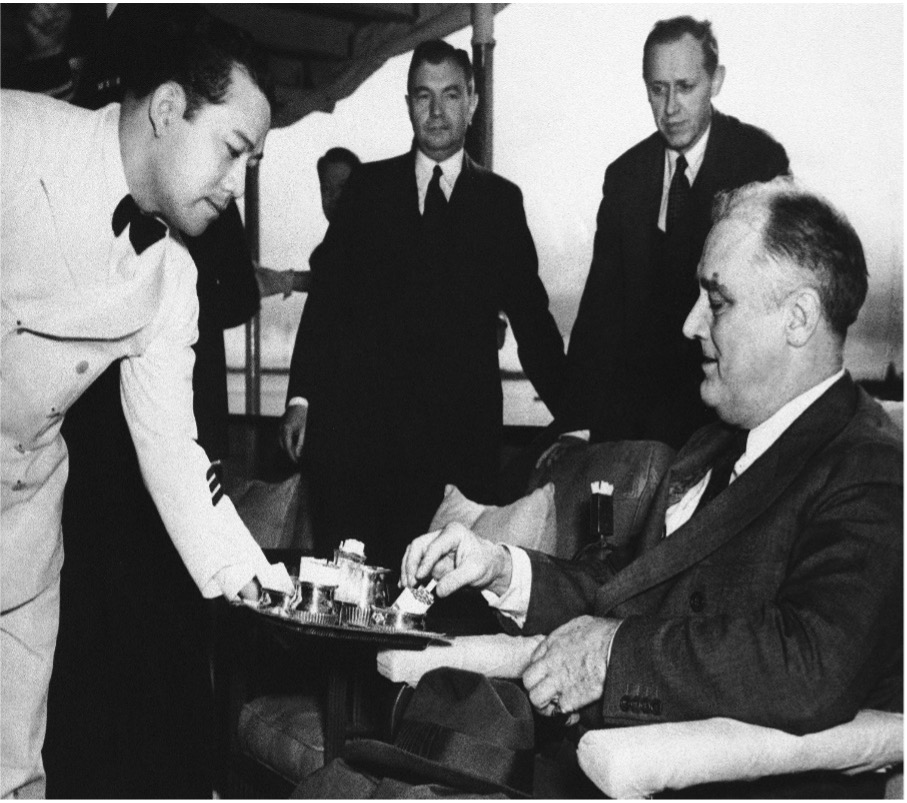 Irineo Esperancilla (FDR called him Isaac), a chief steward on the Filipino staff, described his specific orders[4] aboard the Potomac to include:
- You will sleep on the fantail after all the guests have turned in. In case of inclement weather, you may sleep in an easy chair in the wardroom. You will not go below at any time unless ordered to do so.
- You will at all-time be available in case of an emergency to assist the president to his room and will close all windows in his cabin.
- In case of abandon ship, you will assist in transfer of the president to another ship or boat.
Food was important to FDR but not the First Lady. He would win World War II, but he surrendered control of his meals to White House Housekeeper Henrietta Nesbitt. Selected by First Lady Eleanor and sharing her liberal politics, Mrs. Nesbitt had no experience in food planning but was in charge of the White House menu and ruled the domestic staff like a Prussian field marshal. FDR announced early on that he disliked broccoli, yet Mrs. Nesbitt kept serving it to him. He would ask for coffee and get iced tea. The New York Times ran a story in 1937 headed “Same Meal Four Days Irks Roosevelt.” He told friends he wanted a fourth term, “just so I can fire Mrs. Nesbitt.” He died. She survived. Finally, she crossed First Lady Bess Truman who ended her tyranny.
The USS Potomac Filipino mess crew provided some culinary relief and accompanied FDR on shore to cater when he entertained outside the White House. Most notably, they joined him for the World War II Cairo and Teheran conferences in 1943. His mess crew was already on the USS Iowa with their provisions including turkeys for Thanksgiving dinners when President Roosevelt transferred in secret from the Potomac in Chesapeake Bay. He re-joined his mess staff and the senior leadership of the U.S. war effort to start a 17,442-mile roundtrip for dinners and meetings that included the D-Day invasion decision and plans for the final stages of World War II.
After the president boarded the Iowa, the presidential yacht shoved off. She was instructed to remain out of sight and incommunicado with the shore for a period not less than a week to create an impression that the President might be onboard instead of at risk crossing the Atlantic.
Commander William Rigdon managed the Filipino staff from the White House. He served as Assistant Naval Aide to the Chief Executive of the United States. In his book, “White House Sailor,” he writes:
“I was early put in charge of the wonderful Filipino stewards from the Presidential yacht who always accompanied the President away from Washington to prepare and serve his meals, and also the big luncheons and dinners he often gave. They were loyal. They were tireless. Often they were sleepless-and always they worked silently.”
Thanksgiving was in Cairo for meetings with Churchill. Roosevelt wanted a “family affair” traditional American Thanksgiving dinner for Churchill and his daughter Sara. His Filipino mess crew prepared two enormous turkeys and pumpkin pies served with champagne while an army band was playing. The turkeys were brought to the dining table by Chief Stewards Orig and Esperancilla to be carved for more than 20 guests by FDR propped up high in his chair. He calculated correctly with just enough left for himself, asking each guest, “Light meat or dark.”[5] Things got a little rowdy as the evening wore on. Churchill wearing a one-piece bomb-shelter, zippered-up suit ended up dancing with FDR’s appointment secretary “Pa Watson.” FDR wrote in a trip diary, “It is an enormous satisfaction to have my mess crew from the Potomac and Shangri-La, music by an army band, & later W.S.C. cake-walked with Pa Watson.”[6] Churchill recalled, “for a couple hours we cast care aside.” Compliments to their chefs.
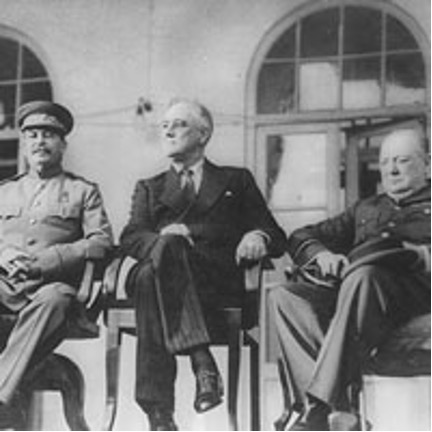 On to Teheran for the first meeting of the Big Three including Joseph Stalin. He had insisted on that venue for military reasons over the repeated objection of President Roosevelt. If FDR was going to get a “face-to-face” with Stalin, it would have to be Teheran, or he would send a delegate. Another problem was the American legation (a smaller version of an embassy) was located on the outskirts of the city about 1.5 miles from the centrally located British and Soviet embassies where Churchill and Stalin would be staying requiring risky city travel for meetings. FDR had insisted on American quarters, but Soviet intelligence learned the Germans were aware of the Big Three meeting and had dropped parachutists in the nearby Russian occupied area near Teheran, a probable assassination squad. That did it. The President chose moving to the Russian Embassy to reduce urban travel and, hopefully, strengthening his personal ties to Stalin. Hidden microphones were a then unknown problem.
Now the entire delegation had to get to the Russian Embassy with a team of Nazi assassins reported to be in the neighborhood. Deception was the best route. The Filipino mess crew joined the staff in a “fake motorcade” with a secret service agent in a bullet proof vest posing as FDR winding through the main city street to the Russian Embassy. Meantime, the real FDR was in a car with a single jeep in the lead racing through the side streets to the embassy.
On Nov. 28, 1943, after an extensive discussion of planning for the Normandy Invasion at the first formal conference session, steak and potatoes were on the menu the mess staff served when FDR hosted the first Big Three ceremonial dinner. Before the meal he served Stalin his favorite hand-stirred martini. “All right, but a little cold on the stomach,” was Stalin’s critique. The dinner had been at risk. The kitchen had been stripped of range and utensils. At the last moment the Army brought a field range, a supply of coal, cooking utensils, with a lot of food just in case.[7]
The conference ended on December 1. FDR, his delegation and staff including the mess crew started on the long journey home on the USS Iowa that would meet again the USS Potomac for the President to transfer to the Presidential Yacht for the final leg back to the White House.
After catering for the allied leadership of World War II, his Filipino mess staff would return to their local duties providing the President with occasional relief from Mrs. Nesbitt’s food tyranny still in command at the White House.
The crew’s final service to FDR for an international World War II conference was at Yalta when he met for the last time with Churchill and Stalin in February 1945. Probably, their most challenging assignment was the meal service for King Ibn Saud of Saudi Arabia on the USS Quincy on the way home from Yalta.
Moored at Great Bittler Lake, midway in the Suez Canal, the Quincy received King Saud who arrived on U.S. Navy transport for his first trip outside his kingdom. It was his first trip on a ship. Paired down to a retinue of 42 attendants, not the usual several hundred, and 86 live sheep (the king liked his meat fresh), the royal party boarded the Quincy. The mess crew had been alerted that the menu would be lamb (obviously) and to make it spicy.
A great success! The king said the “… meal was the first he had eaten in a long time that was not followed by digestive disturbance and he would like, if the President would be so generous, to have the cook as a gift.” Ordona, the chief cook, went into hiding while FDR explained the cook was under a fixed term contract with the Navy.[8]
With the full Filipino mess crew intact and aboard the Quincy, FDR returned to Washington on February 27. President Roosevelt died 44 days later at Warm Springs, Georgia, on April 12, 1945.
[1] Letter to President Teddy Roosevelt from John Hay, then American ambassador to the United Kingdom
[2] William Randolph Hearst reportedly replied to a photographer who said there was no war to cover in Cuba, “You furnish the pictures. I’ll furnish the war.”
[3] Shangri-La was renamed Camp David by President Dwight D. Eisenhower for his grandson in 1953.
[4] A Glimpse of Greatness” by Irineo Esperancilla
[5] “White House Sailor” by William Rigdon with James Drieux
[6] “Franklin and Winston” by Jon Meacham
[7] “White House Sailor” by William M. Rigdon with James Derieux
[8] “White House Sailor” by William M. Rigdon with James Derieux