

Vice President Harry Truman liked to spend afternoons with a bourbon and branch at House Speaker Sam Rayburn’s “Board of Education” hideaway. When he arrived on April 12, 1945, Rayburn told Truman to call Steve Early in the White House right away. Truman dialed National 1414 and was told to come to the White House as “quickly and quietly” as he could. It sounded ominous. Truman lost his color muttering, “Jesus Christ and General Jackson.”
When he arrived, Mrs. Roosevelt put her arm on Truman’s shoulder. “Harry, the President is dead.” Unable to speak at first, he finally managed, “Is there anything I can do for you.” She replied, “Is there anything we can do for you …. You are the one in trouble now.”
He took the oath of office at 7:09 p.m., two hours and 24 minutes after FDR’s death at Warm Springs, Georgia. Truman had been Vice President for 82-days. He had met with President Roosvelt only twice, except for cabinet meetings. He was not aware of the Manhattan project to develop the atomic bomb or the results of FDR’s just completed Yalta conference with Churchill and Stalin. He had not met the new Secretary of State, Edward Stettinius.
So ended an era and so began another.[1] The Presidential Yacht Potomac had a new skipper.
The new President had a lot going on. He moved from his $120 monthly rental apartment to Blair House across from the White House while Mrs. Roosevelt packed and then another move to the White House. He had met with Vyacheslav Molotov, the Russian prime minister. On April 24, he received a note from Secretary of War Stimson saying, “I think it is very important that I should have a talk with you as soon as possible on a highly secret matter.”[2] On April 25 he opened the San Francisco UN conference by radio from the White House. He celebrated his 61st birthday on May 8. On that same day Alfred Jodl, the chief of staff of the German High Command signed Germany’s unconditional surrender, at General Eisenhower’s headquarters in Reims, France. Truman announced Germany’s surrender in a radio address from the White House. On June 26, he delivered an address in San Francisco at the closing of the U.N Charter Conference.
Amidst this activity, he scheduled his first cruise as President on the Potomac on a sunny May 6 Sunday. It was strictly a family affair, the President, his wife Bess and daughter Margaret. Together with five secret service men, they boarded the yacht and cruised down the Potomac River for about three hours before returning to the Navy Yard berth at about 5:30 p.m.
On May 11, Truman sent his four-engine plane the Sacred Cow[3] to pick-up his 92-year-old mother Martha Ellen Young Truman and his 56-year-old sister Mary Jane for their first visit with the new president in the White House. When offered bedding in the Lincoln Room, the President’s mother, a true confederate, said she instead preferred the floor. Alternative sleeping was arranged. They had arrived in time for a Mother’s Day cruise on the Potomac.
The Potomac was not just for the family. There was also time for the boys. On May 29-30, the President hosted a poker party on the ship overnighting at anchor offshore of Quantico, VA, marine base with Harry Vaughan, Captain James Vardaman, Jr., George Allen, Steve Early and George Allen. The President wrote in his diary “his sides were sore from laughing.”
The new President’s greatest early challenge was the forthcoming Potsdam World War II conference in Germany. He was scheduled to meet with Stalin and British leadership to plan for a post war world with an increasingly hostile Russian ally. Without the benefit of any direct input from President Roosevelt, Truman had a major research project to prepare for meeting and negotiating with his more seasoned counterparts. A quick study, he took to the files and records plus getting input from participants in the earlier war conferences.
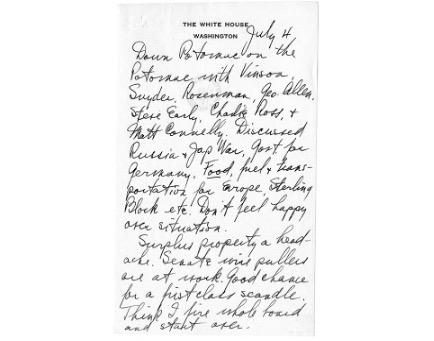
Before leaving for Potsdam on the USS Augusta[4], he boarded the USS Potomac on July 4, 1945, for a working cruise to prepare for the war conference and discuss other strategic issues including the war with Japan. Joining him aboard were Fred M. Vinson, John W. Snyder, Samuel I. Rosenman, George Allen, Steve Early, Charlie Ross, Capt Vardaman, and Matt Connelly for a 9:24 a.m. departure returning at 4: 49 p.m. Truman made a handwritten note to himself from the Potomac:
“Down Potomac … Discussed Russian & Jap War, Govt for Germany, Food, fuel & transportation for Europe, Sterling Block, etc. Don’t feel happy over situation.”
He also noted: “I have to decide Japanese strategy—shall we invade Japan proper, or shall we bomb[5] and blockade? That is my greatest decision to date. But I’ll make it when I have all the facts. So you see, we talk more than ‘Cabbages & Kings and Sealing wax and things.’”
Snyder, Rosenman and Allen later wrote a memorandum summarizing the issues discussed with the President on the July 4 Potomac cruise including strategies for the Potsdam conference that concluded after a long list of priorities:
“In other words, we think that as a well known Missouri horse trader, the American people expect you to bring something home to them.”
Just what he didn’t need …. more pressure!
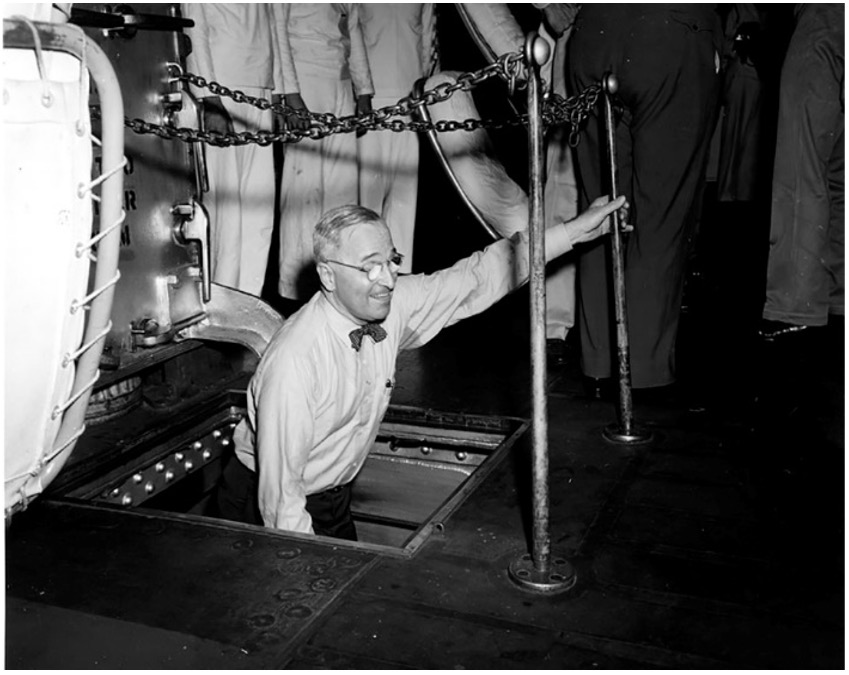 After the July 4 Potomac discussions, he continued preparing for Potsdam with long hours at the White House before departing for the conference on board the USS Augusta on July 7 from Newport News, VA. Like the support for FDR’s war councils, Truman was accompanied by 11 members of the Filipino mess crew from the Presidential Yacht USS Potomac. Included was Chief Steward Irineo Esperancilla, a favorite of President Roosevelt. Another Filipino on this trip from the Potomac was Benjamin Licodo. He had been on the PT Boat that took General MacArthur and his family off Corregidor but stayed behind for two years fighting the Japanese in guerrilla warfare.[6]
The Potomac mess crew provided culinary support throughout the July 17 to August 2 Potsdam Conference. After the conference returning to Washington D.C. on the USS Augusta, President Truman authorized the dropping of the first atomic bomb on Hiroshima, Japan, by a B-29 bomber on August 6. A second bomb was dropped on Nagasaki on August 9.
September 3, 1945, is the last entry on the USS Potomac logs showing President Truman onboard. He was joined by his wife Bess for a day cruise passing Mount Vernon on the voyage up and down the river rendering “passing honors” on each occasion.
Victimized by its conversion from a “rum chaser” coast guard cutter, the Potomac was “top heavy” with new upper decks outfitted for a presidential yacht. Consequently, she was restricted to inland waters. The new President selected the larger and more seaworthy USS Williamsburg as his new replacement presidential yacht.
The USS Potomac was decommissioned as a Navy vessel on Nov. 18, 1945.
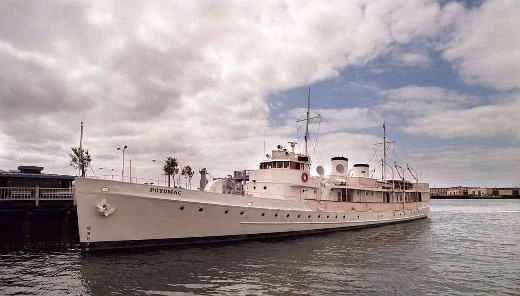
See USS Potomac mini-history “From a ‘Rum Chaser’ to a ‘Drug Runner’” for the saga of the ship now fully restored as Franklin Roosevelt’s Presidential Yacht at Jack London Square in Oakland, California, by the Association for the Preservation of the Presidential Yacht Potomac. The Potomac is the oldest Navy ship (decommissioned) still in daily operation.
[1] Source: “Truman” by David McCullough
[2] The “matter” was the atom bomb dropped first on Hiroshima on Aug 6, 1945, as authorized by President Truman
[3] AKA “The Flying White House”
[4] The USS Augusta (Georgia not Maine) was a heavy cruiser used by President Roosevelt for his 1941 secret meeting with Prime Minister Winston Churchill when he was supposed to be fishing on the USS Potomac.
[5] The Trinity test of the first atomic weapon in the desert of New Mexico remined 12 days away.
[6] Source: “White House Sailor” by William M. Rigdon with James Derieux