
For fourteen years between1920 and late 1933, the United States was “dry.” The 18th Amendment to the U.S. Constitution, “Volstead Act,” prohibited alcoholic sales, manufacture, and consumption throughout the United States.
Still despite the “cure,” the public generally wanted its liquor. A widely held public attitude to ignore the law followed. In the 1920’s, New York City’s Mayor Fiorello LaGuardia said it would take “250,000 policemen to enforce the law and an equal number to watch them.” Gangsters grew rich. It was estimated Al Capone earned $60 million a year (he should have paid his taxes). Sacramental wine was still permitted for religious purposes. The number of questionable rabbis and priests skyrocketed. New York City boasted more than 30,000 speakeasies, and Detroit’s alcohol trade was second only to the automobile industry in its contribution to the economy.
Prohibition created a whole new industry … rum running. A fleet of ships hovered outside the 12-mile sea limit out of reach to the U.S, Coast Guard seizing opportunities to bring their contraband off-shore alcoholic cargo to the eager American market. At the start of Prohibition, no one predicted the level of smuggling from sea to follow. By 1924, it was estimated that the Coast Guard was apprehending about 5% of the “rum runners” with its fleet of about “…200 vessels at sea attending to the rummies at any given time.”[1]
In the Napa Valley “creative” wineries managed to survive usually by making wine for permitted religious purposes, one of the loopholes in the 18th Amendment. Other wineries made wine for home use, turned their grapes into raisins or simply sold their grapes directly to customers. Could it have been possible that, maybe, some bottles even found their way to the speakeasies? Surviving Napa Valley wineries included Beringer, Beaulieu, Charles Krug, Louis M. Martini, Freemark Abbey and Larkmead.
In October 2029, the stock market crashed. The 1920’s “roar” was now silent. For nearly three years stock prices declined irregularly, losing almost 90 per cent of their 1929 value. A nationwide change in public sentiment about Prohibition was underway. More and more were agreeing that the “cure” had been worse than the “disease.” Also, the “sick” Great Depression economy needed taxes from alcohol sales and lessened law enforcement expenditures.
When Franklin Roosevelt made his 1932 nomination acceptance, he announced that Prohibition was doomed. Congress started the process before his inauguration. On his eighth day in office, he told his advisors, “It’s time the county did something about beer.” Less than 30-hours later the “beer bill” passed among the FDR’s New Deal legislation. On April 6, 1933, a police detail escorted a beer truck to the White House under a sign reading, “President Roosevelt, the first real beer is yours.”
[2]Ratification of the appeal was needed by 36 States which Utah provided and on Dec. 5, 1933, the 21st constitutional amendment repealed the Volstead Act and Prohibition came to an end. A failed move to remake private behavior was over after 14 years.
Perhaps, our country has always been divided. During Prohibition it was “wet” versus “dry.” FDR was “wet.” Eleanor was “dry.” FDR’s mother, Sarah, was “dry” and even post repeal continued to enforce her local prohibition in the family home at Hyde Park.
The USS Potomac was first born as the Coast Guard Cutter Electra in the design style developed in World War I for submarine chasers with sharp lines… a racked bow and cruiser stern … for speed to combat smuggling. The first of these new sleek “Rum Chasers” was launched in 1931. The Electra was the seventeenth of the series and delivered in 1934 after Prohibition had been reappealed two years earlier. Construction had continued. Coastal patrol was still a priority including a new threat from offshore “tax free” liquor. The Electra spent her first eleven months patrolling the coast.
Meanwhile, President Roosevelt was using the wooden-hulled Sequoia from 1933 to 1936 as his presidential yacht. Uncomfortable with her from the outset, FDR began looking for a replacement almost immediately. He was taken by the clean lines and functional appearance of the Electra class of Coast Guard cutters. Also, he was comforted by the Electra’s steel hull for fire prevention and better design for deep-sea fishing.
She was politically correct … “devoid of the varnished hardwood, polished brass and interior finery found on the Sequoia, the Electra was firm, austere and businesslike … altogether a thoroughly proper yacht for a president leading his country out of the worst economic depression in history.”[3]
The press release announcing her selection as the new presidential yacht only mentioned that she was able to carry more passengers.
The subchaser Electra was transferred from the Coast Guard to the U.S. Navy in 1935 and classified as AG25 (“Auxiliary Miscellaneous”). Now a new name had to be chosen, not a simple process. The President considered a wide choice including ship names from throughout American history. While at Warm Springs, he selected “POTOMAC” from a wide list and issued a memo … “The name has been changed from the Electra to the Potomac.”
The Norfolk Navy Yard was designated as the Potomac’s home yard and Washington, D.C. was assigned her home port where she was transformed into a presidential yacht including a hand operated elevator concealed in a new after stack that allowed the president to appear magically on one dock or the other. The conversion cost was $60,000.
The Potomac was commissioned as a Navy vessel on March 2, 1936, at the Norfolk Navy Yard. Her first voyage as the presidential yacht was an extended fishing trip off the coast of Florida that began on March 23, 1936. It was the first of many similar trips off the Atlantic and Gulf coast and the southern waters[4].
FDR loved the time he relaxed and contemplated on the Potomac. Additionally, she served strategically as secret transport for two of his World War II international conferences …. Atlantic Conference in 1941 with Churchill and the Teheran Conference with Churchill and Stalin in 1943 to finalize D-Day planning for the Normandy Invasion.
Cocktails were part of the daily routine on the USS Potomac post prohibition including FDR’s specially crafted martini (Stalin said it was cold on the stomach). Still the “drys” including his mother exercised their authority. After a luncheon cruise on the yacht for King George VI and Queen Mary in 1939, the royal couple visited his mother’s Big House at Hyde Park. FDR told the king that his mother did not approve of cocktails and thought he should have a cup of tea. The king reflected for a moment and observed, “Neither does my mother.” They raised their glasses and proceeded to drink their martinis.[5]
When President Roosevelt died at Warm Springs on 1945, the Potomac’s days as presidential yacht were numbered. Later that year, she was returned to the Coast Guard and sold to the State of Maryland on July 16, 1946. Purchase price $10 including provisions and supplies. At some point during the Maryland era, the state removed the after stack with FDR’s hand-operated elevator which is currently a monument to the president at Cambridge, Maryland. In 1958, there was a nautical accident with the dredge Arlington that damaged both propellers and a rudder post. That was enough. The state started looking for buyers. She was sold to Warren G. Toone in 1960 for $65,000, later less $8,000 for repairs revealed by a survey.
This started a downhill path that would lead her literally underwater. She now pointed her bow toward the Caribbean for a proposed inter-island ferry service between the Virgin Islands and Puerto Rico which did not happen. She languished in Barbados accumulating unpaid bills and lacking maintenance. The yacht became unseaworthy.
Hydro-Capital bought the ship planning a restoration and journey to appear at the Seattle’s World Fair (Century 21 Exposition). In 1962 a crew of ten arrived from Los Angeles to make her seaworthy for the journey to Seattle. Some progress was made, and she started her West Coast journey but with more hard luck on the horizon including the loss of her starboard engine. After passing the Panama Canal, heading for California into swells so adverse she ran out of fuel off Mexico but got enough to reach San Diego and then Long Beach. The exhibit in Seattle was cancelled.
Now berthed at King’s Harbor in Redondo Beach, the ship was cleaned-up for static public display as the former presidential yacht but had mooring problems and was declared a “menace to navigation” and ordered removed from the harbor. This was enough for Hydro-Capital. She was moved to Long Beach for public auction.
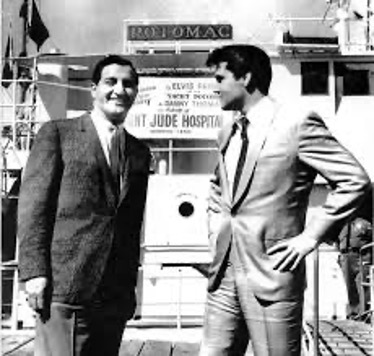 On Jan. 30, 1964, the Potomac was purchased by Elvis Presley. He paid $55,000, in his words, to “keep it from winding up in a junk heap.”[6] He intended giving it to The National Foundation-March of Dimes to become a national FDR monument and fund raiser. Originally delighted but after more investigation into upkeep costs, they politely refused. He looked for other takers including St. Jude Children’s Research Hospital in Memphis, Tennessee. She would be moved to Memphis and made into a floating restaurant. A favorite charity, he planned to “hand over the keys” on Feb. 3, 1964, to Danny Thomas, founder and key-fund raiser for St. Jude’s. On the handover day, he joined with Danny Thomas and his “Memphis Mafia” on the Potomac deck for speeches, photographs, and autographs.
After the ceremony, the hospital became aware of the costs involved in ownership and relocation and decided to stay in the “hospital business” not the “boat business.” Presley’s contributions included $8,000 to paint one side (shoreside) for the press conference.
Elvis’ attorneys arranged for a second sale this time from St. Jude’s to Marie Pagliasso. She was the heir to the estate of “Dutch” Leonard, a former pitcher for the Boston Red Sox and fan of the Roosevelts. She formed a group that obtained a bank loan with a third-party guarantee to purchase her for $62,500. The ship’s decline was about to accelerate.
For several years she led the restoration effort, but the “group” fell apart and a lawsuit over ownership ensued. The Potomac was put up for sale again on Sept. 13, 1966. This time she was berthed at Marina Del Ray, Los Angeles. No acceptable bids were received, and she retained ownership in failing health, not making payments until her death in 1970 when ownership transferred to Carton Taylor, the man who guaranteed the original loan. He tried selling her with an advertisement in the Wall Street Journal in 1970 but ended up making a “verbal agreement” to lease her to Aubrey Phillips, a commercial fisherman, private investigator, and Long Beach bail bondsman who seemed “…like a terrific, nice guy[7].”
Phillips moved her to Portofino in Redondo Beach. Once more she sat, deteriorating. Over the years, we find her berthed at different southern California harbors until February 1979 when she was towed from Los Angeles to Stockton.
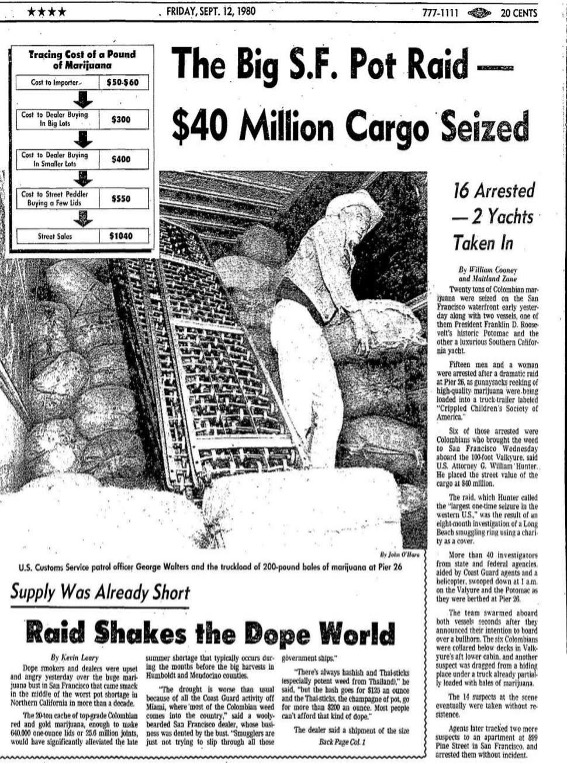
In August 1980, Phillips moved the Potomac to Pier 26 in San Francisco, allegedly for repairs. She was joined on Sept. 10 by the Valkyure, an 85-footer, overloaded with 21-tons[8] of Columbian marijuana worth $40 million[9] on board. Both vessels flew the black and yellow flag of the Crippled Children’s Society of America, a bogus charity. In the early morning hours of Sept. 11, offloading the marijuana began from the Valkyure to a waiting truck also draped with the Crippled Children’s Society flag. At 1 a.m., a U.S. Coast Guard helicopter lighted the scene for what U.S. Attorney G. William Hunter[10] characterized as “the largest one-time seizure in the Western U.S.” The Potomac was not carrying any marijuana but along with the Valkyure was “arrested”[11] for being part of the illegal activity.
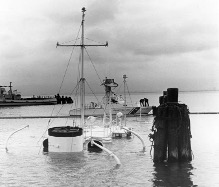 Now “busted” the former law enforcing Electra was moored and “arrested” at Treasure Island in San Francisco Bay under federal custody. Six months later on March 18, 1981, while in federal custody, the USS Potomac’s hull was holed by broken pilings, and she sank at her Treasure Island berth in thirty-five feet of water.
The Potomac had reached the lowest point in her career. It had to be raised!
After it was decided in federal court that the ship had been forfeited, it was purchased on April 21, 1981, by the Port of Oakland in public auction. Their winning (and only) bid was $15,000.
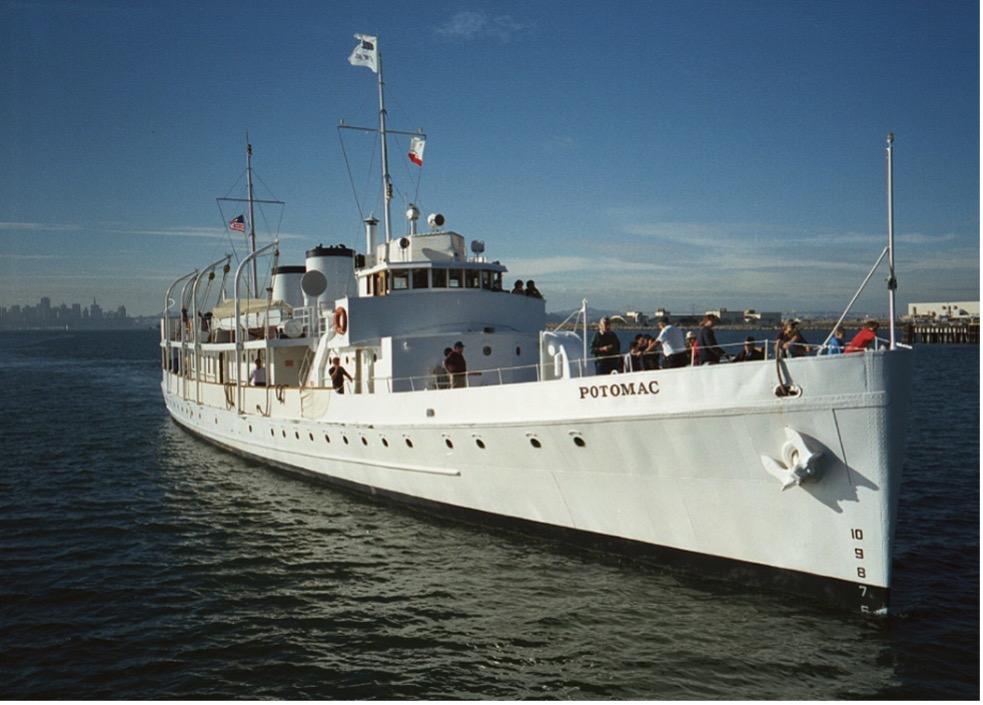
The Association for the Preservation of the Presidential Yacht Potomac, a non-profit organization, was created to lead the restoration effort working with the Port. After raising more than $5 million in private and government funding, the USS Potomac was fully restored and started public operations on May 20, 1995.
Today she is the oldest Navy ship (decommissioned) still in daily operation and the only nationally recognized memorial to FDR in the western states.
Alcohol and marijuana were the bookends of her earlier life both now legal where launched and seized.
[1] “Rum War at Sea” by Malcolm F. Willoughby, Commander USCGR(T)
[2] “The War on Alcohol” by Lisa McGirr
[3]“ The Presidential Yacht Potomac” by Capt. Walter W. Jaffee
[4] See USS Potomac mini-histories … “FDR Texas Fishing Trip” and “Florida Fishing Trip”
[5] “No Ordinary Time” by Doris Kearns Goodwin
[6]“ The Presidential Yacht Potomac” by Capt. Walter W. Jaffee
[7] Aubrey Phillips would later be sentenced to thirty months in federal prison for his role in drug smuggling involving the Potomac.
[8] 25.6 million joints
[9] Later valued at $250,000 in court documents
[10] G. William Hunter later was appointed to the Oakland Board of Port Commissioners, the next owner of the USS Potomac
[11] Under maritime law a ship can be arrested and treated as it if were a person