
Personal Advisor to FDR for the Great Depression and World War II
(1912 Class President Grinnell College)
Next after FDR and his “little dog Fala,” the USS Potomac passenger with the most nautical miles was likely Harry L. Hopkins, the president’s valued advisor and closest companion during the war years. He was frequently with FDR on the ship for cruises, fishing trips, and strategy sessions.
Harry had joined the Roosevelt administration when the President was governor of New York managing his welfare outreach. He continued as head of the Works Progress Administration (WPA) to implement FDR’s New Deal. He served as Secretary of the Interior during Roosevelt’s second administration.
He had lost a large part of his stomach to cancer which severely restricted his intake of vital nutrients rendering him frequently at “death’s door” needing emergency restoration at the Bethesda Naval Hospital or the Mayo Clinic. After blood transfusions, other treatments and rest, he would be medically revived for “one more” assignment including matching cigarette to cigar and drink for drink in late night sessions with Winston Churchill.[1]
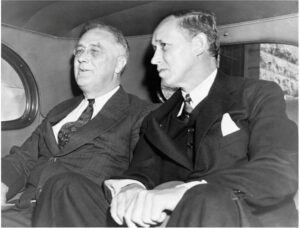
FDR with Harry Hopkins 1938
Hitler’s next target was Great Britain. At the time, the smart money including U.S. Ambassador to Great Britain Joseph Kennedy, father of President John F. Kennedy, and military experts were predicting Churchill’s forces would not be able to hold.
FDR had a dilemma. The country was largely anti-war and isolationist. His second term in office was coming to an end. America’s own defenses were in sorry shape. War was coming our way. He internalized that his leadership was critical to America becoming the “Arsenal of Democracy” for its allies and to prepare for the country’s own defense.
He decided to seek an unprecedented third term if he could engineer to be “spontaneously” drafted at the Democrat National Convention scheduled for July in Chicago. Retreating again to the Potomac for a two-day cruise with his political advisors to plan how to run when not running. His strategy worked (see the USS Potomac Mini-History “FDR’s Run for a Third Term”). He was nominated by the Democrats in Chicago and on Nov. 5, 1940, Franklin D. Roosevelt defeated Wendell Willkie for an unprecedented and never to be duplicated third term with 54.7% of the popular vote.
Now he had to prepare the country for the very war he had disavowed during the campaign. He needed to find a way to get armaments and supplies to a financially stressed Great Britain without the reimbursement required by the “Neutrality Act.” To lend not sell the materials was FDR’s plan.
A sense of doom pervaded Washington and London. Almost everywhere the British were forced into the defensive. German General Erwin Rommel was dominating in Egypt. Hitler’s U-boat wolf packs were sinking hundreds of merchant ships in the North Atlantic. Shipyards and port facilities in England were constantly pounded by massive air attacks. The war as a whole was slipping away. The survival of civilization seemed in Jeopardy.[3]
Should FDR even lend to Great Britain? Lending and then losing armaments to a victorious Germany would threaten our own security. The President wanted to assess Great Britain’s odds of surviving the Nazi assault. Most importantly, he needed to establish a personal relationship with Winston Churchill. He had met Churchill only once before when he was Assistant Secreatary of the Navy under Woodrow Wilson. Churchill at first did not recall the meeting to FDR’s irritation.
The President sent Harry Hopkins on a two-week trip in January 1941 to meet with Churchill and assess the overall situation in Great Britain including its strength to resist the Nazi attack. To Churchill, Hopkins was the country’s most important visitor in his lifetime. Two weeks stretched to almost five including three weekends with Churchill and family at bone-cold Chequers, his country home, and a personal lunch with the King and Queen[4]. While Harry was assessing Great Britain’s needs, the critical Lend Lease legislation was approved by the House over strong opposition by Charles Lindberg and other isolationists. Churchill then declared to a joint British American radio audience, “Give us the tools and we will finish the job.” FDR and Harry knew Lend Lease was critical to saving Great Britain but not sufficient to “finish the job.”
Before returning, Harry set the stage for a later personal meeting between the two heads of state, where the USS Potomac would play another historic role.
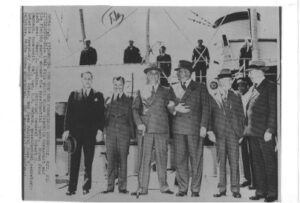
FDR and guests before boarding USS Potomac for 1941 Florida Fishing Trip (Hopkins left)
The first lend lease appropriation of $7 billion had just passed Congress a week earlier and was signed by the President while on the Potomac. He presented Harry with the signature pen and also a letter dated March 27, 1941, appointing him “to advise and assist the President in carrying out the responsibilities placed upon him by lend lease at an annually salary of $10,000.” It was not as good as the $12,000 Harry made as Secretary of Interior in 1940 but better than no salary received for his “volunteer” assignments to that date. He would run Lend Lease out of his Lincoln Suite in the White House.
Harry got in a little trouble with the Boss on the trip when the Potomac was at berth in Ft. Lauderdale because of high winds. He showed up with Attorney General Jackson and Press Secretary Steve Early dressed to go out on the town in Miami after dinner. FDR jumped on him like an angry father saying he was there for rest and that he would never take him on another trip if he went out. Harry went to bed early that night.
As Lend Lease was starting up, the customer base doubled. On June 21, 1941, Hitler turned east and invaded Russia “Operation Barbarossa” on an 1,800-mile front with three million German troops. It was doubtful Russia could hold out.
In July, FDR decided Harry needed to go back to London for more meetings with Churchill to discuss the Lend Lease needs and convoy protection. He was instructed not to discuss the U.S. entering the war. He was also tasked with arranging the time and place of a shipboard meeting between the president and Churchill. On July 17, 1941, Harry met again with Churchill, this time as friends, at No. 10 Downing Street. Harry explained that the President wanted to meet him during the second week of August in “some lonely bay or other.” Placentia Bay in Newfoundland was chosen, the date of August 9 was fixed, and Churchill placed his newest battleship, The Prince of Wales[6], under orders accordingly.[7]
Busy with lend lease and war strategy issues, Harry found time to weekend with Churchill at Chequers complete with Cuban cigars, drinks, and late-night conversations. While there he met for the first time Ivan Maisky, the Soviet Ambassador to Great Britain, who was convinced that Hopkins was dead serious about helping the Soviet Union. The Germans had captured Smolensk, Russia’s oldest city, and were threatening to encircle Leningrad (now St. Petersburg). When Hopkins asked what supplies were needed, the ambassador suggested he visit Moscow to get the information. Hopkins cabled the President for approval which was received back in hours. Churchill immediately scheduled the travel arrangements so that Hopkins would be back in time to join Churchill on the HMS Prince of Wales for their forthcoming shipboard meetings with President Roosevelt in Newfoundland.
Harry arrived in Russia with a personal note from FDR to Stalin reading, “Treat Mr. Hopkins with the identical confidence you would feel if you were talking to me.” On the evening of July 30, 1941, Hopkins, accompanied by the U.S. Ambassador and an interpreter, met with Marshall Stalin in his Kremlin office. He accepted Stalin’s offer of a cigarette and reciprocated with a Camel having been told it was the marshal’s favorite brand. They got to business quickly identifying Russia’s needs. Stalin laid it all out. The next evening, they met a second and final time but with just Hopkins and Stalin and his interpreter. Stalin provided an assessment of the war situation, probably optimistic, for Hopkins to advise FDR. The meeting ended after almost four hours. Hopkins was convinced this was a fight to the death.
The trip to Russia brought Hopkins close to death another time. He forgot his medications when he left Moscow, arriving in Scotland boarding the Prince of Wales in a state of near collapse needing a blood transfusion and bedrest. Two days later the great battleship with Churchill, his entourage[8] and a reviving Hopkins would start the dangerous journey across the North Atlantic to meet President Roosevelt in Newfoundland.
In Washington, FDR announced plans for a 10-day fishing trip on the USS Potomac off the coast of New England[9]. On this trip, the fish would be spared. He left Washington by train on August 3 to New London, Connecticut, where he transferred in front of thousands to the presidential yacht. After being observed by the public and press in the New England waters, FDR transferred in secret with Fala to the Cruiser USS Augusta. The Potomac still flying his flag cruised the Cape Cod Canal for public consumption with a suitably dressed imposter complete with tilted cigarette-holder fishing over the side.
On August 8, President Roosevelt watched from the USS Augusta at anchor in Placentia Bay, Newfoundland, the arrival of Churchill’s party including Hopkins (and probably Rufus) on the HMS Prince of Wales. Meetings, including the war planners, continued back forth for four days on the two ships. Roosevelt and Churchill worked on a draft document signed separately that became known as the “Atlantic Charter.” It set forth the vision and principles of the post war world and became the foundation for the United Nations.
Harry had transferred back to the American side with FDR and Fala when the Augusta reconnected with the Potomac. To allow safe passage time for Churchill to get back to Great Britain, they took their time coming back to resurface publicly on the presidential yacht.
Back on the Potomac, FDR held a shipboard press conference on August 16, including Hopkins, in Rockford, Maine. Mindful of the country’s still isolationist mood, FDR downplayed the meeting which had included the top military planners of both governments and emphasized instead a “…very remarkable religious service.” The Atlantic Charter statement was “…an exchange of views, that’s all. nothing else.” To the reporter who asked if America was closer to war. Roosevelt replied, “I should say, no.”
The Japanese answered differently on December 7, 1941, and Hitler settled the question four days later by declaring war on the United States.
Harry Hopkins would remain at FDR’s side for the duration of the war joining him for all the offshore war conferences applying his unique personal relationships with the three leaders, FDR, Churchill and Stalin.
They were just once more on the USS Potomac, another secret assignment for the presidential yacht[10]. The Potomac had transferred to Quantico Marine Base in Virginia on Nov. 11, 1943. The President with a small party including Harry left the White House for Quantico in secret after dark to board the ship and cast off immediately down the river toward the Chesapeake Bay. Anchoring overnight in the river, the president and his party transferred to the USS Iowa the next morning for the next stage of a 17,442-mile trip that included the Tehran war conference where Roosevelt, Churchill and Stalin met for the first time. Hopkins was the single individual who had connected personally with all three leaders. At the conference Stalin made a rare point of displaying his personal consideration for Harry who despite his ill health had made the exhausting and hazardous journey to Moscow in 1941, to help the besieged Russian people. The big three agreed to the date for Operation Overlord, and with Harry’s personal touch overcoming Churchill’s long-standing resistance to the Normandy Invasion. On Dec. 16, 1943, the Iowa returned the President and Harry to the presidential yacht for an overnight on board before the final leg home to Washington the next morning. This was their last trip on the USS Potomac.
The Potomac was not involved in the next war conference in Yalta, but Harry was. Returning home with FDR on the USS Quincy after the meetings, Harry was too sick to continue and disembarked at Algiers on February 18, 1945, leaving the president to continue home without him. The two would never see one another again.
Franklin Roosevelt died on April 12, 1945, at Warm Springs.
Hopkins immediately became President Truman’s source for all-things Roosevelt and to prepare the new president for the forthcoming final war conference at Potsdam. Post war relationships with the Soviet Union started to fray. In May 1945, Hopkins managed a final visit, this time for Truman, to meet again with Stalin (six separate sessions). But his contact with life was growing slender, as Churchill said about Roosevelt. The end came on January 29, 1946, with Harry L. Hopkins saying “You can’t beat destiny” before slipping into a coma. He was 55-years old[11].
[1] Winston Churchill re Harry Hopkins “His was a soul that flamed out of frail and failing body.” Source: “The Hopkings Touch” by David L. Roll
[2] The Blue Room – Lincoln Study where the Emancipation Proclamation was signed.
[3] Source: “The Hopkins Touch” by David L. Roll
[4] Harry Hopkins had been on board the USS Potomac with King George VI and Queen Mary for the1939 luncheon cruise to Mount Vernon
[5] Robert H. Jackson is the only American to serve as Solicitor General, Attorney General and U.S. Supreme Court Justice. He also was the chief U.S. prosecutor in the Nuremberg German War Criminals trial.
[6] HMS Prince of Wales was sunk by Japanese bombers on Dec. 10, 1941, while returning to Singapore with the loss of 327 sailors. The wreck is nearly upside down on the bottom off Kuantan, Malaysia. The site has been designated as a ‘Protected Place, under the British Protection of Military Remains Act 1986.
[7] Source:”The Hopkins Touch” by David L. Roll
[8] Some records show that Churchill’s entourage included Rufus, his pet poodle. FDR’s entourage definitely included Fala, his Scottie.
[9] See USS Potomac Mini-History “Atlantic Conference with Winston Churchill – August 1941”\
[10] See USS Potomac mini-history “USS Potomac’s Role in President Roosevelt’s Tehran Conference”
[11] Source: “The Hopkins Touch” by David L. Roll